
How to Use Neurodivergent Support Planner Bundle
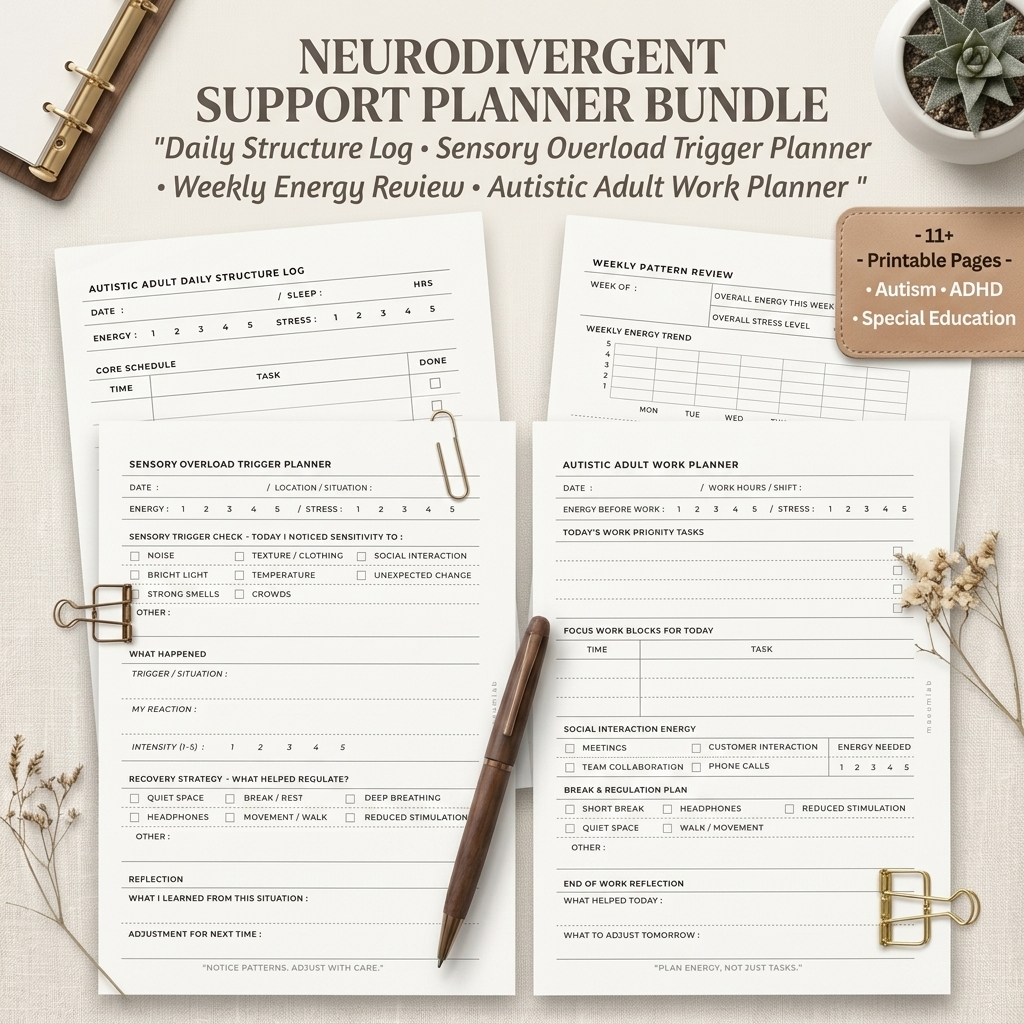
Notice • Support • Adjust • Recover
Daily life can require more energy than it appears to from the outside.
Sensory input, social interaction, unexpected changes, work demands, emotional regulation, and everyday routines can all affect how much capacity you have available.
The Neurodivergent Support Planner Bundle is a collection of 8 printable tools designed to help you notice those patterns and make practical adjustments based on what you actually need.
Rather than asking you to push through or follow a rigid routine, these pages help you understand the connection between your energy, sensory needs, emotions, environment, and daily demands.
HOW TO USE THIS BUNDLE
You do not need to use all 8 planners every day.
Choose the page that matches what you need right now.
Need more structure today?
Use the Daily Structure Log.
Feeling emotionally overwhelmed?
Use the Emotional Regulation Planner.
Noticing overload building?
Use the Overload Warning Signs Log.
Recovering from sensory overload?
Use the Sensory Recovery Planner.
Trying to understand a sensory trigger?
Use the Sensory Overload Trigger Planner.
Social interaction is draining your energy?
Use the Social Battery Planner.
Want to understand patterns across the week?
Use the Weekly Pattern & Energy Review.
Need support navigating the workday?
Use the Autistic Adult Work Planner.
THE GOAL IS NOT PERFECT TRACKING
You don’t need to fill every box or complete every section.
Use these pages as tools for noticing:
What happened?
How did it affect me?
What helped?
What could I adjust next time?
Over time, your entries can help you recognize patterns and build a more personalized collection of supports.
START WITH WHAT YOU NOTICE.
You don’t need to understand everything immediately.
Notice the pattern. Try a support. Keep what helps. Adjust what doesn’t.
01 | EMOTIONAL REGULATION PLANNER
Notice the Emotion. Notice the Body. Find What Helps.
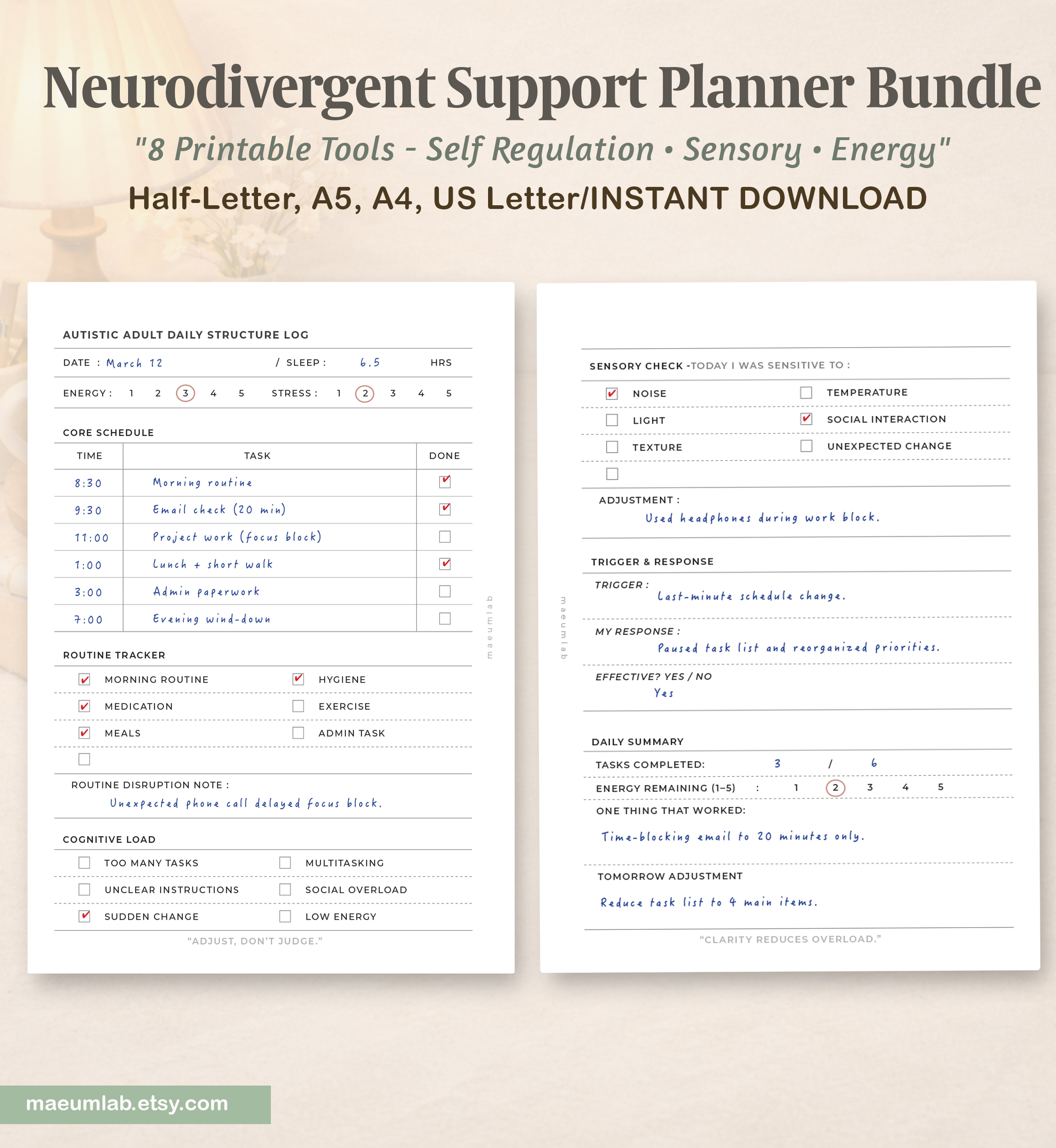
The Emotional Regulation Planner helps you pause and look at what is happening emotionally and physically during or after a difficult moment.
Use it to identify your current state, notice possible triggers, try a regulation strategy, and record what actually helped.
1.CHECK YOUR ENERGY & STRESS
Start by rating your current:
Energy Level: 1–5
Stress Level: 1–5
You don’t need to overthink the numbers. They are simply a quick snapshot of how you’re feeling at that moment.
Over time, these ratings can help you notice whether certain emotions or situations tend to happen when your energy is low or stress is already high.
2. IDENTIFY THE EMOTION
Check the emotions that best describe what you noticed.
You might feel:
Calm • Focused • Anxious • Frustrated • Overwhelmed • Irritated • Restless • Sad • Tired
More than one can be true at the same time.
Use Other when the emotion you are experiencing isn’t listed.
3. NOTICE YOUR BODY SIGNALS
Next, check what you noticed physically.
For example:
- Muscle tension
- Faster heartbeat
- Stomach discomfort
- Difficulty focusing
- Headache
- Restlessness
These signals can sometimes appear before you fully recognize that stress or overwhelm is building.
4. NOTICE WHAT MAY HAVE CONTRIBUTED
Use the trigger section to briefly record what was happening.
Example:
Unexpected change to my afternoon schedule after an already busy morning.
Then rate the Emotion Intensity from 1–5.
You don’t need to determine the exact cause. Simply record what you noticed.
5. TRY A REGULATION STRATEGY
Check anything you tried:
- Quiet space
- Short break
- Deep breathing
- Movement or walking
- Listening to music
- Reduced stimulation
Use Other for strategies that are personal to you.
The purpose isn’t to find one strategy that always works.
It’s to discover which supports tend to help you, in which situations.
6. REFLECT BRIEFLY
Finish with two simple questions:
What helped most?
What will I try next time?
Keep your answers short and practical.
Example:
What helped most?
10 minutes alone in a quiet room.
Next time:
Take the break earlier instead of waiting until I’m completely overwhelmed.
LOOK FOR PATTERNS
After using the planner several times, look back at your entries.
You may begin to notice:
Low energy + high demands → more overwhelm
Unexpected changes → increased stress
Noise + fatigue → difficulty focusing
Early break → easier recovery
Those patterns are often more useful than any single entry.
REMEMBER
The goal isn’t to control every emotion.
It’s to understand your signals earlier and learn what support helps.
Notice first. Support yourself. Adjust from what you learn.
02 | AUTISTIC ADULT WORK PLANNER
Plan Your Work Around Energy — Not Just Tasks
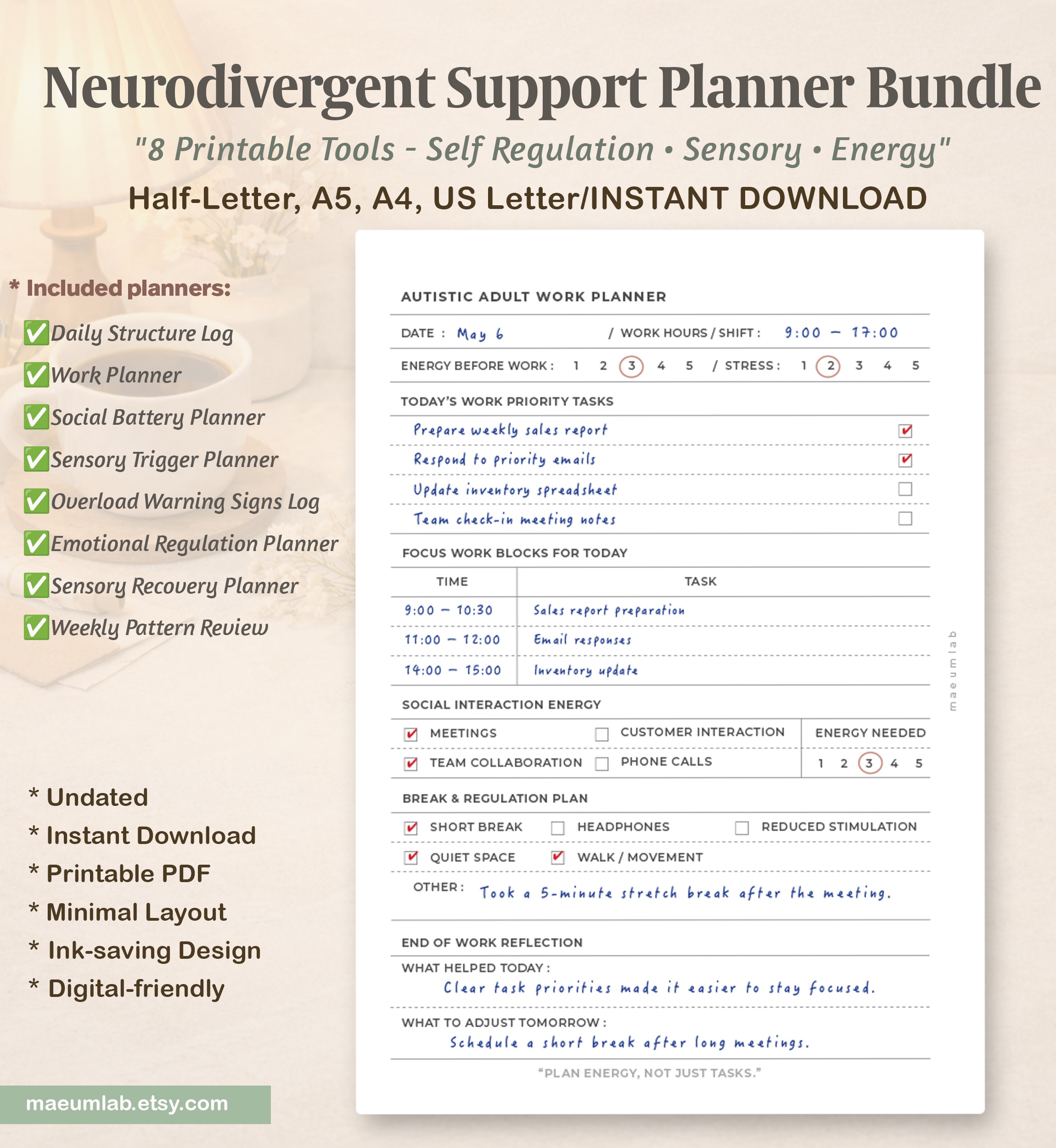
The Autistic Adult Work Planner helps you organize your workday while considering energy, stress, focus demands, and the impact of social interaction.
Instead of filling every available hour with tasks, use this page to decide what matters most, protect focused work time, and plan regulation breaks before your energy is depleted.
1.CHECK YOUR STARTING CAPACITY
Before work, record:
Energy Before Work: 1–5
Stress: 1–5
Use these numbers as a quick snapshot of your starting capacity.
If energy is already low or stress is high, consider reducing the day’s workload, shortening focus blocks, or planning additional recovery time.
2. CHOOSE TODAY’S PRIORITIES
Write the tasks that matter most today.
Example:
- Prepare weekly sales report
- Respond to priority emails
- Update inventory spreadsheet
- Review team meeting notes
You don’t have to complete everything on the list.
Use it to identify where your available energy is most useful.
3. PLAN FOCUS WORK BLOCKS
Give demanding tasks a defined time rather than expecting yourself to stay focused indefinitely.
Example:
9:00–10:30 — Sales report preparation
11:00–12:00 — Email responses
2:00–3:00 — Inventory update
Leave room between blocks whenever possible for transitions, breaks, or unexpected demands.
4. ANTICIPATE SOCIAL ENERGY
Check any social demands expected during the day:
Meetings • Team Collaboration • Customer Interaction • Phone Calls
Then estimate the Energy Needed: 1–5.
This can help you recognize that a meeting or phone call may require energy even when it doesn’t look like a traditional “task.”
If you expect a high-social-demand period, consider protecting some quieter time before or afterward.
5. PLAN BREAKS & REGULATION SUPPORT
Don’t wait until you’re completely depleted to decide what might help.
Choose supports in advance:
- Short break
- Quiet space
- Headphones
- Walk or movement
- Reduced stimulation
- Another strategy that works for you
Example:
Take a 5-minute stretch break after the meeting.
The goal is to make regulation part of the work plan — not something you only use after reaching overload.
6. END WITH A QUICK REFLECTION
At the end of the workday, answer:
What helped today?
What should I adjust tomorrow?
Example:
What helped today?
Clear priorities made it easier to stay focused.
What to adjust tomorrow:
Schedule a short break after long meetings.
Keep this section simple. One useful observation is enough.
LOOK FOR PATTERNS
After using the planner several times, you may begin to notice patterns such as:
Meeting-heavy days → more recovery time needed
High stress at the start → shorter focus blocks work better
Clear priorities → less cognitive overload
Quiet time after social interaction → easier transition back to focused work
Use those observations to make future workdays fit your actual capacity more closely.
REMEMBER
Productivity isn’t only about how many tasks you complete.
Protecting your energy can be part of getting meaningful work done.
Plan the task. Plan the energy. Plan the recovery.
03 | SOCIAL BATTERY PLANNER
Notice the Energy Cost of Social Interaction
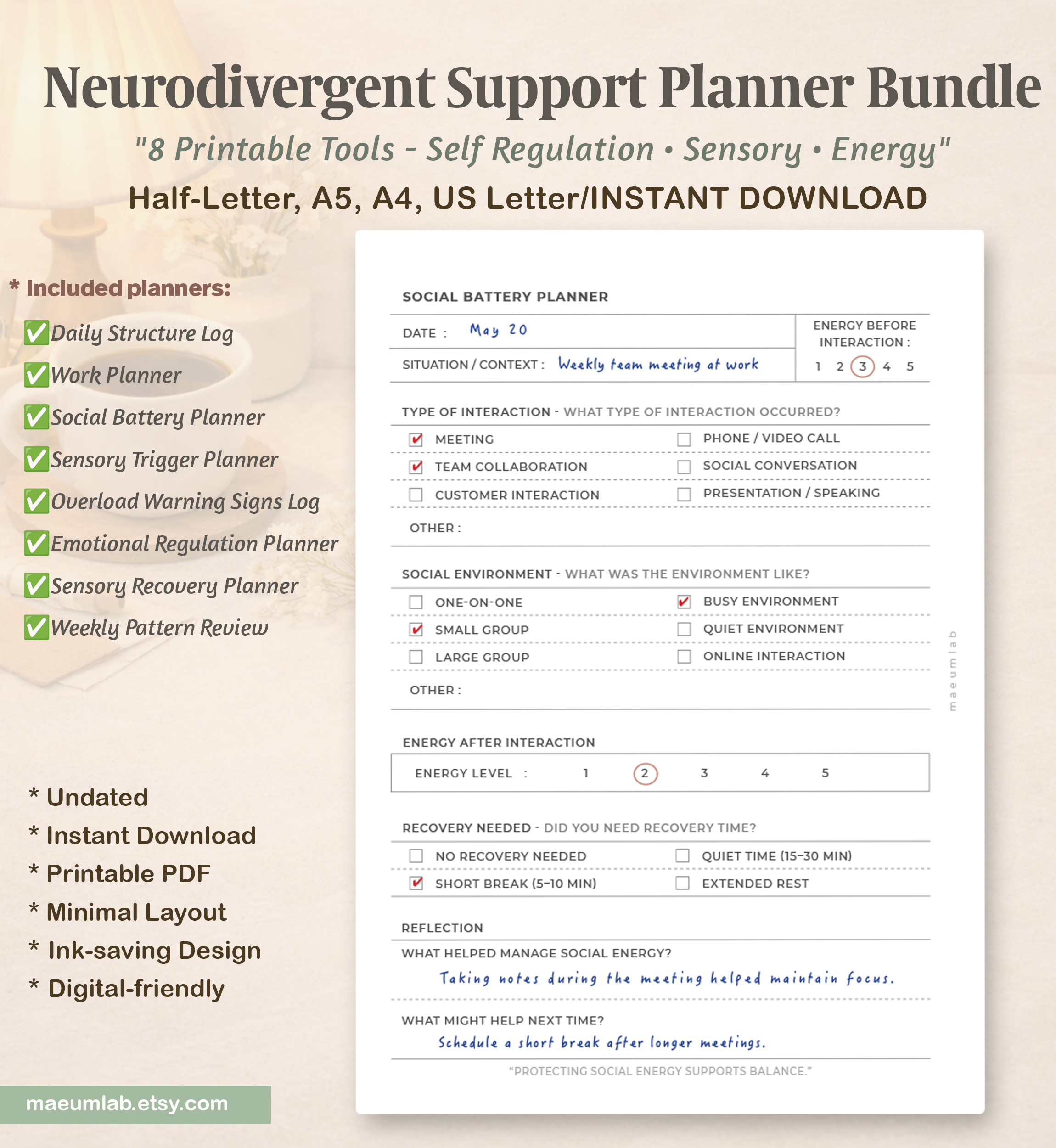
The Social Battery Planner helps you understand how different types of social interaction affect your energy.
A meeting, phone call, casual conversation, or group activity may require very different amounts of energy depending on the situation and environment.
By comparing your energy before and after an interaction, you can begin to recognize which situations are more draining — and what helps you recover.
1. RECORD THE SITUATION
Write down the interaction you want to track.
Example:
Weekly team meeting at work
Then rate your:
Energy Before Interaction: 1–5
Think of this as your starting point rather than a score you need to improve.
2. IDENTIFY THE TYPE OF INTERACTION
Check what kind of interaction occurred.
For example:
- Meeting
- Team collaboration
- Customer interaction
- Phone or video call
- Social conversation
- Presentation or speaking
More than one may apply.
This helps you compare different kinds of social demands over time.
3. NOTICE THE SOCIAL ENVIRONMENT
Next, record what the environment was like.
One-on-One • Small Group • Large Group • Busy Environment • Quiet Environment • Online Interaction
The setting can matter just as much as the interaction itself.
For example, a small meeting in a quiet room may affect your energy very differently from the same meeting in a noisy, crowded environment.
4. CHECK YOUR ENERGY AFTERWARD
After the interaction, rate:
Energy After Interaction: 1–5
Compare this number with your starting energy.
Example:
Before interaction: 3
After interaction: 2
You don’t need to calculate anything formally. Simply notice whether your energy stayed relatively stable, dropped slightly, or dropped significantly.
5. NOTICE YOUR RECOVERY NEED
Check what you needed afterward:
- No recovery needed
- Short break (5–10 min)
- Quiet time (15–30 min)
- Extended rest
Recovery needs are useful information.
Needing a break after a demanding interaction doesn’t mean the interaction went badly — it simply tells you something about its energy cost.
6. REFLECT ON WHAT HELPED
Finish with two short questions:
What helped manage social energy?
What might help next time?
Example:
What helped?
Taking notes during the meeting helped me stay focused.
Next time:
Schedule a short break after longer meetings.
Keep the reflection practical. One small adjustment is enough.
LOOK FOR YOUR SOCIAL ENERGY PATTERNS
After several entries, compare your Social Battery pages.
You might discover:
Large groups → greater energy drop
Video calls → less draining than in-person meetings
Busy environments → more recovery needed
Back-to-back meetings → faster depletion
Quiet time afterward → easier recovery
These patterns can help you plan demanding interactions with more realistic expectations.
REMEMBER
The goal isn’t to avoid every interaction that uses energy.
It’s to understand the cost, protect your capacity, and plan recovery when you need it.
Notice the demand. Protect your energy. Make room for recovery.
04 | SENSORY OVERLOAD TRIGGER PLANNER
Identify Triggers. Notice Your Response. Adjust the Environment.
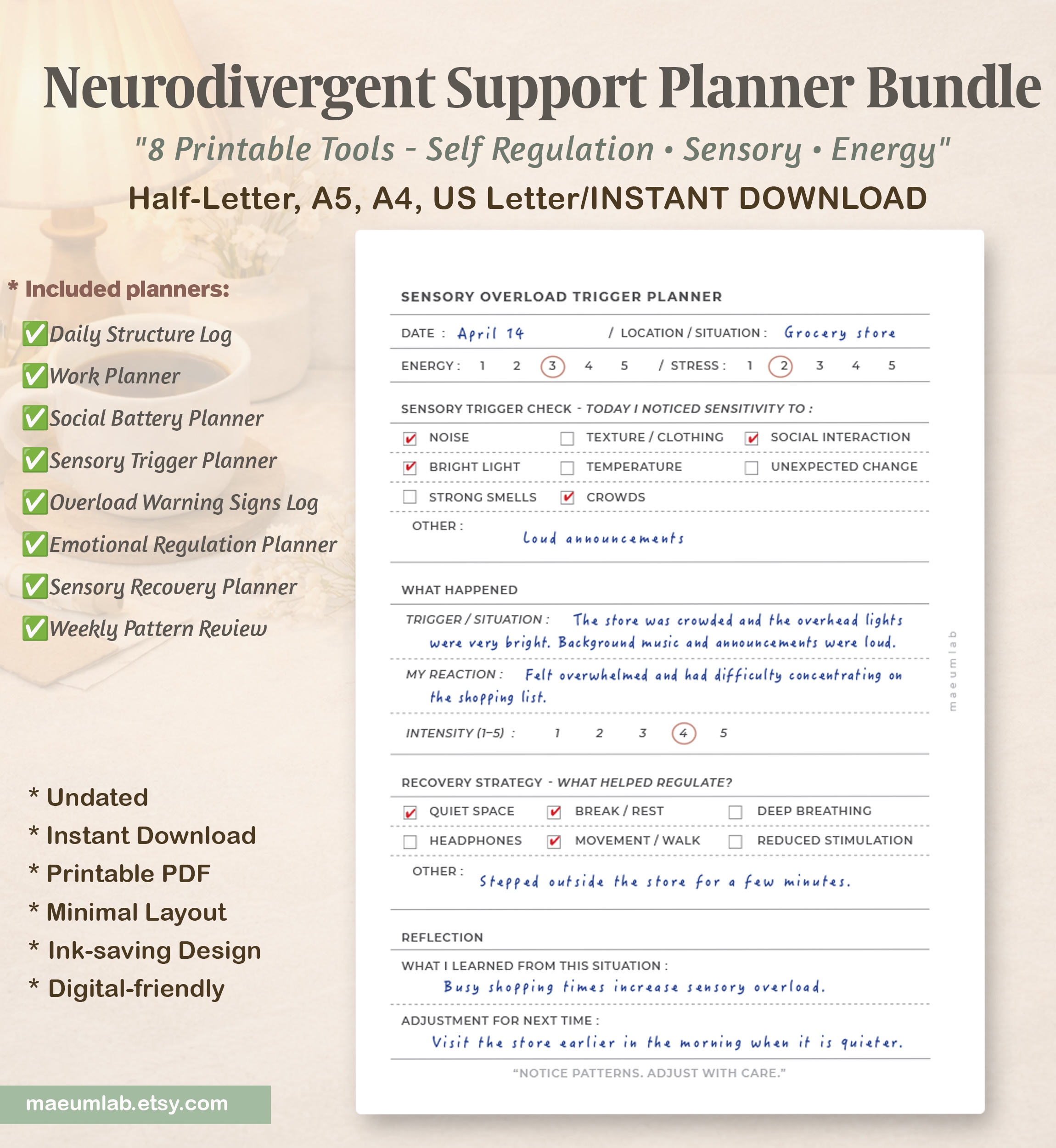
The Sensory Overload Trigger Planner helps you identify sensory and environmental factors that may contribute to overload.
Use it after a difficult situation — or whenever you notice increased sensory sensitivity — to record what happened, how strongly it affected you, and what helped you regulate.
Over time, these entries can help you recognize patterns and make supportive adjustments before overload becomes more intense.
1. START WITH THE CONTEXT
Record the:
Date
Location / Situation
Energy Level: 1–5
Stress Level: 1–5
Example:
Location: Grocery store
Energy: 3
Stress: 2
Your starting energy and stress matter.
The same environment may feel manageable on a high-capacity day and overwhelming when you’re already tired or stressed.
2. CHECK THE SENSORY TRIGGERS
Check anything you noticed sensitivity to:
- Noise
- Bright light
- Strong smells
- Texture / clothing
- Temperature
- Crowds
- Social interaction
- Unexpected change
Use Other for anything not listed.
More than one trigger can be checked.
Example:
Noise + Bright Light + Crowds + Social Interaction
You don’t need to decide which one was “the cause.” Sometimes overload comes from several smaller demands building together.
3. RECORD WHAT HAPPENED
Briefly describe the situation.
Trigger / Situation:
The store was crowded, the overhead lights were very bright, and announcements were loud.
Then record:
My Reaction:
Felt overwhelmed and had difficulty concentrating on the shopping list.
Finally, rate the:
Intensity: 1–5
The purpose isn’t to judge your reaction. The rating simply helps you compare experiences over time.
4. RECORD WHAT HELPED
Check the regulation strategies you used:
- Quiet space
- Break / rest
- Deep breathing
- Headphones
- Movement / walk
- Reduced stimulation
Add your own strategy under Other when needed.
Example:
Stepped outside the store for a few minutes.
Pay attention to which strategies actually helped — not just which ones you tried.
5. REFLECT & ADJUST
Finish with:
What I learned from this situation
and
Adjustment for next time
Example:
What I learned:
Busy shopping times increase sensory overload.
Adjustment for next time:
Visit the store earlier in the morning when it is quieter.
The adjustment doesn’t need to eliminate the trigger completely.
Even a small change can reduce the total sensory demand.
LOOK FOR COMBINATIONS
After several entries, look beyond individual triggers.
You might notice:
Noise alone → manageable
but
Noise + crowds + low energy → overload
or:
Bright lights + long shopping trip → increasing difficulty focusing
This can help you understand your personal sensory load, rather than assuming one trigger is always responsible.
REMEMBER
Sensory overload isn’t always caused by one thing.
Sometimes it’s the accumulation of several demands at once.
Notice what adds to the load. Keep what helps. Adjust what you can.
05 | OVERLOAD WARNING SIGNS LOG
Recognize the Signs Before Overload Builds
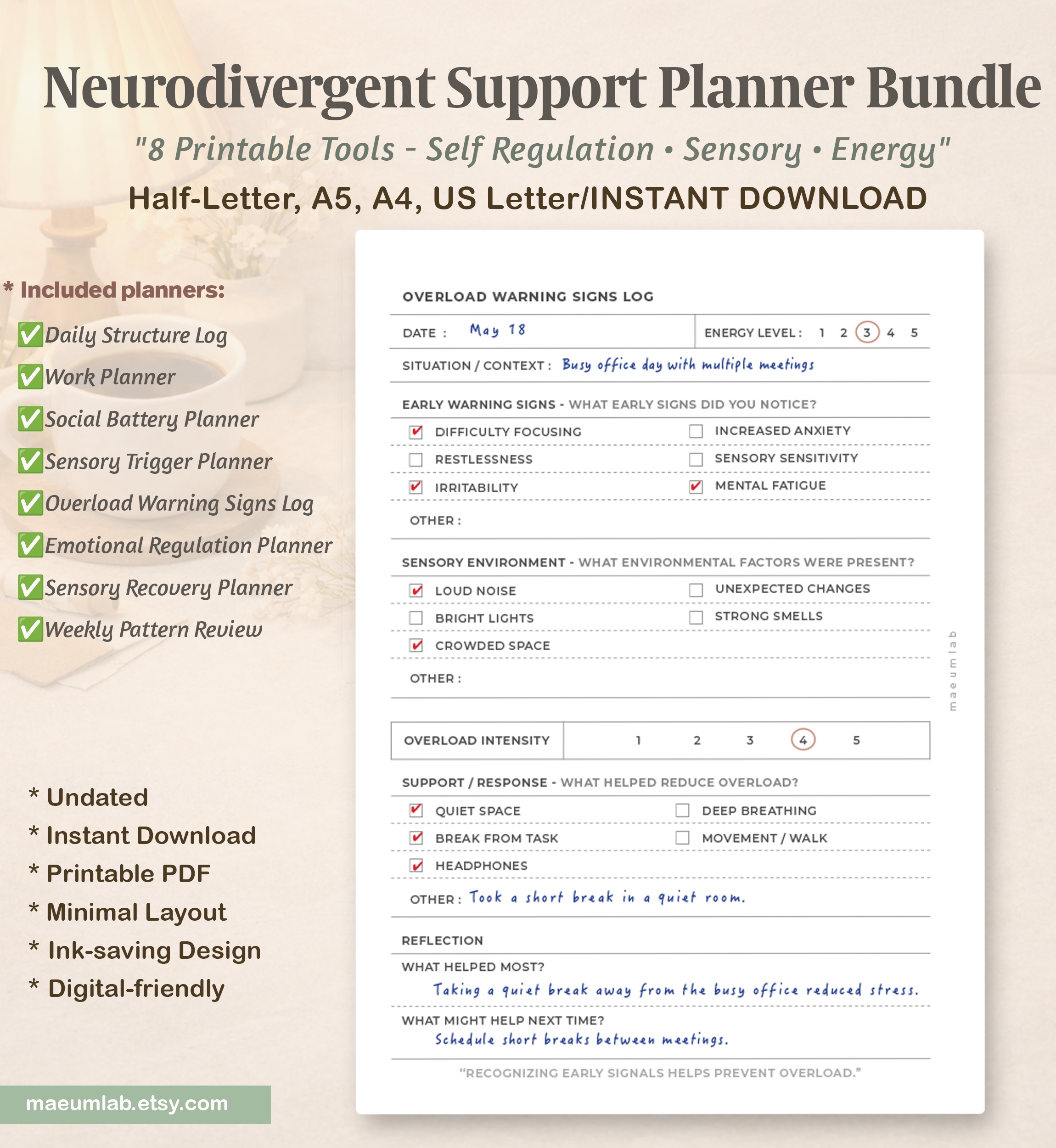
The Overload Warning Signs Log helps you identify the early signals that may appear before you reach a higher level of overwhelm.
Difficulty focusing, irritability, anxiety, sensory sensitivity, restlessness, or mental fatigue can sometimes be early clues that your capacity is becoming stretched.
The goal is not to prevent every difficult moment. It is to become more familiar with your own signals so you can respond earlier when possible.
1. RECORD THE CONTEXT
Start with:
Date
Energy Level: 1–5
Situation / Context
Example:
Busy office day with multiple meetings
Your energy level provides useful context.
You may notice that warning signs appear sooner on days when your starting energy is already low.
2. NOTICE YOUR EARLY WARNING SIGNS
Check anything you noticed:
- Difficulty focusing
- Restlessness
- Irritability
- Increased anxiety
- Sensory sensitivity
- Mental fatigue
Use Other for signs that are specific to you.
Example:
Difficulty focusing + Irritability + Mental fatigue
Don’t worry about whether a sign “counts.”
If you notice a change from your usual state, record it.
3. NOTICE THE ENVIRONMENT
Next, check any environmental factors that were present:
- Loud noise
- Bright lights
- Crowded space
- Unexpected changes
- Strong smells
Sometimes a warning sign makes more sense when you look at what was happening around you.
Example:
Loud noise + Crowded space
Over time, you may discover that certain environments make your early warning signs appear more quickly.
4. RATE THE OVERLOAD INTENSITY
Rate your experience:
Overload Intensity: 1–5
This helps you compare situations later.
For example, you may eventually notice that difficulty focusing at Level 2 often comes before irritability and mental fatigue at Level 4.
That information can help you recognize your own escalation pattern.
5. RECORD YOUR RESPONSE
Check what you tried to reduce the overload:
- Quiet space
- Break from task
- Headphones
- Deep breathing
- Movement / walk
Add anything else under Other.
Example:
Took a short break in a quiet room.
You don’t need to try every strategy.
The useful question is simply:
Did this help reduce the load?
6. REFLECT ON WHAT HELPED
Finish with:
What helped most?
What might help next time?
Example:
What helped most?
Taking a quiet break away from the busy office reduced stress.
What might help next time?
Schedule short breaks between meetings.
This turns the page from a record of overload into information you can use next time.
FIND YOUR EARLIEST SIGNAL
After several entries, look for the sign that tends to appear first.
You might notice:
Difficulty focusing → irritability → sensory sensitivity → overload
or:
Mental fatigue → restlessness → anxiety → need to withdraw
Your sequence may be completely different.
Knowing your earliest signals can give you an opportunity to reduce demands or add support before your capacity drops further.
REMEMBER
You don’t have to wait until you’re completely overwhelmed to use support.
Notice earlier. Respond sooner. Protect your capacity.
06 | EMOTIONAL REGULATION TRACKER
Connect the Emotion, Body Signals & Situation
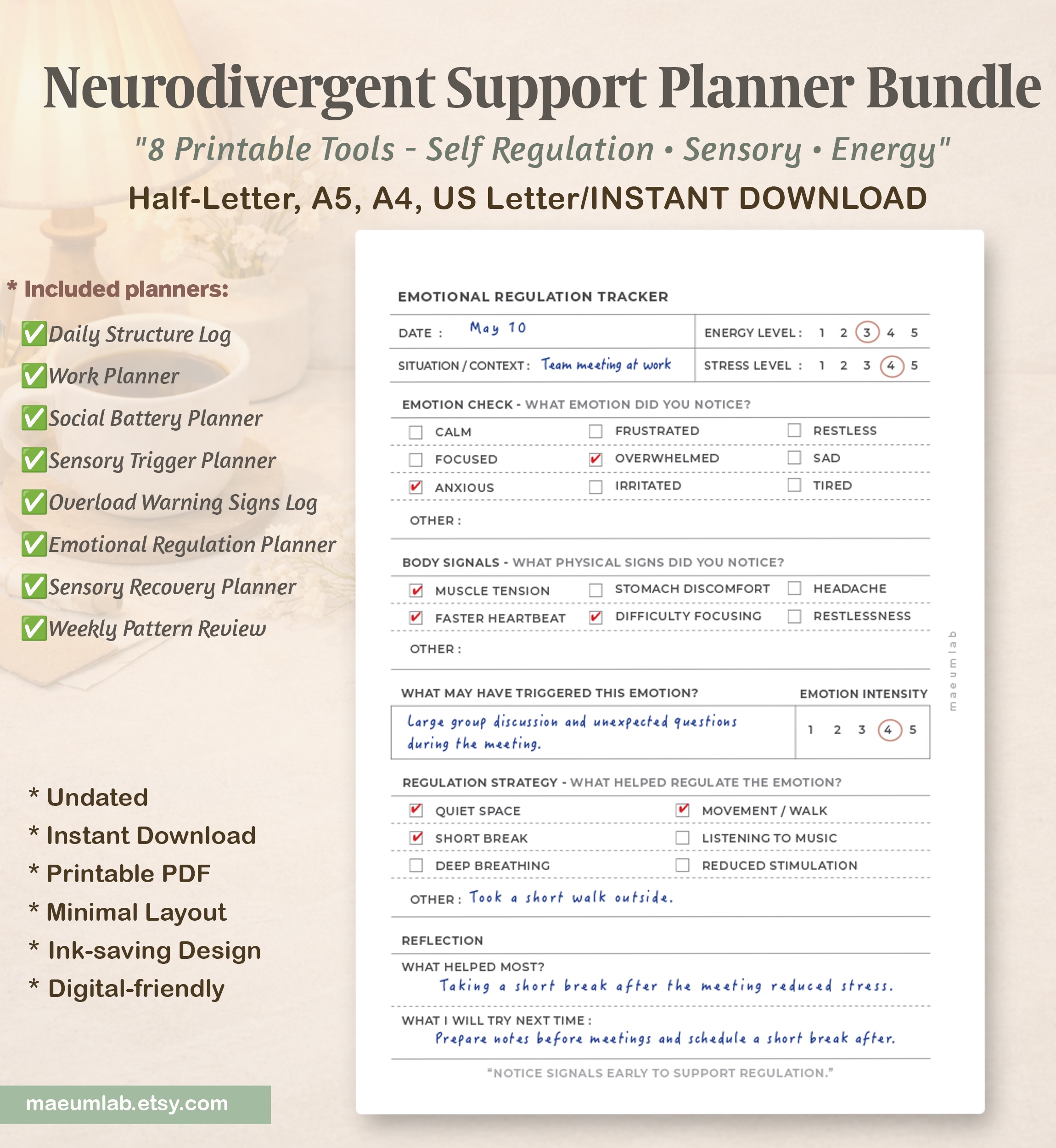
The Emotional Regulation Tracker helps you understand what you were feeling, how your body responded, what may have contributed to the emotion, and which regulation strategies helped.
Use it during a difficult moment if you have the capacity — or complete it afterward when you have more space to reflect.
1. START WITH THE CONTEXT
Record:
Date
Situation / Context
Energy Level: 1–5
Stress Level: 1–5
Example:
Team meeting at work
Energy: 3
Stress: 4
Energy and stress provide useful context for understanding why a situation may have felt more difficult that day.
2. IDENTIFY THE EMOTION
Check any emotions you noticed:
- Calm
- Focused
- Anxious
- Frustrated
- Overwhelmed
- Irritated
- Restless
- Sad
- Tired
You can check more than one.
Example:
Anxious + Overwhelmed
Use Other if the emotion you noticed isn’t listed.
You don’t need to find the perfect label. Choose whatever feels closest.
3. NOTICE THE BODY SIGNALS
Next, check what happened physically:
- Muscle tension
- Faster heartbeat
- Stomach discomfort
- Difficulty focusing
- Headache
- Restlessness
Example:
Muscle tension + Faster heartbeat + Difficulty focusing
Body signals can sometimes tell you that your stress is increasing before you’ve fully identified the emotion.
4. NOTICE WHAT MAY HAVE CONTRIBUTED
Briefly record what was happening before or during the emotional response.
Example:
Large group discussion and unexpected questions during the meeting.
Then rate:
Emotion Intensity: 1–5
You don’t need to prove exactly what caused the emotion.
The goal is simply to notice possible connections.
5. RECORD THE REGULATION STRATEGY
Check what you tried:
- Quiet space
- Short break
- Deep breathing
- Movement / walk
- Listening to music
- Reduced stimulation
Use Other for your own strategy.
Example:
Took a short walk outside.
You may use more than one strategy. Pay attention to which one actually seemed to help.
6. REFLECT & PLAN
Finish with:
What helped most?
What will I try next time?
Example:
What helped most?
Taking a short break after the meeting reduced stress.
Next time:
Prepare notes before meetings and schedule a short break afterward.
The next step doesn’t need to be a major change.
One small adjustment is enough.
LOOK FOR CONNECTIONS
After several entries, you may begin to notice patterns such as:
Low energy + unexpected questions → anxiety
High stress + group discussion → difficulty focusing
Physical tension → early sign of overwhelm
Short break after meetings → easier regulation
These connections can help you recognize what you need earlier.
REMEMBER
Emotions aren’t problems to eliminate.
They can provide useful information about your needs, limits, and environment.
Notice the emotion. Listen to the body. Choose the support.
07 | SENSORY RECOVERY PLANNER
Recover First. Then Notice What Helped.
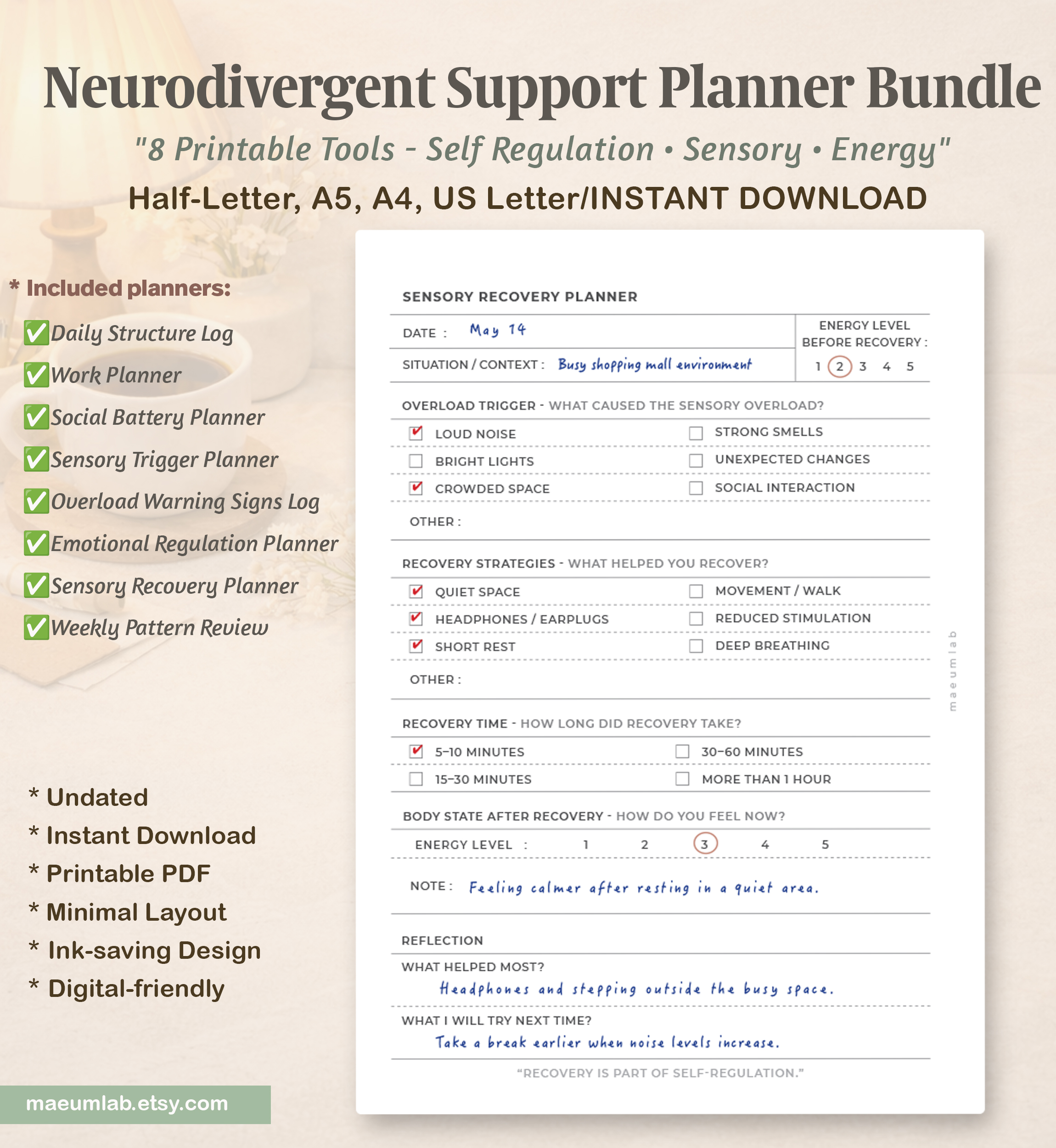
The Sensory Recovery Planner helps you understand what supports your recovery after sensory overload.
Instead of focusing only on what caused the overload, this page helps you track what you tried, how long recovery took, and how your energy changed afterward.
Over time, you can build a clearer picture of what recovery looks like for you.
1. RECORD THE SITUATION
Start with:
Date
Situation / Context
Energy Level Before Recovery: 1–5
Example:
Busy shopping mall environment
Energy before recovery: 2
Keep this section simple. You don’t need to describe the entire event.
2. IDENTIFY THE OVERLOAD TRIGGERS
Check anything that may have contributed:
- Loud noise
- Bright lights
- Crowded space
- Strong smells
- Unexpected changes
- Social interaction
More than one trigger can apply.
Example:
Loud noise + Crowded space
Use Other if something important isn’t listed.
The purpose isn’t to determine one exact cause. It’s to notice what contributed to the overall sensory load.
3. RECORD YOUR RECOVERY STRATEGIES
Check what you used:
- Quiet space
- Headphones / earplugs
- Short rest
- Movement / walk
- Reduced stimulation
- Deep breathing
Use Other for personal strategies that work for you.
Example:
Quiet space + Headphones + Short rest
You don’t need to try multiple strategies. Record what you actually used.
4. TRACK RECOVERY TIME
Estimate how long recovery took:
5–10 minutes
15–30 minutes
30–60 minutes
More than 1 hour
Recovery time isn’t a performance measure.
Some experiences require a few minutes of reduced input. Others may require much longer.
The goal is simply to understand what your system needed.
5. CHECK YOUR BODY STATE AFTER RECOVERY
When you feel ready, rate your:
Energy Level After Recovery: 1–5
Compare it with your energy before recovery.
Example:
Before recovery: 2
After recovery: 3
Then add a short note if helpful.
Example:
Feeling calmer after resting in a quiet area.
Improvement doesn’t have to mean returning immediately to full energy.
Moving from overwhelmed to more settled is meaningful information too.
6. REFLECT ON WHAT WORKED
Finish with:
What helped most?
What will I try next time?
Example:
What helped most?
Headphones and stepping outside the busy space.
Next time:
Take a break earlier when noise levels increase.
This helps turn recovery experience into practical information for future situations.
BUILD YOUR RECOVERY PATTERN
After using the planner several times, look back for patterns.
You may discover:
Noise overload → headphones + quiet space
Crowded environments → stepping outside helps
Low starting energy → longer recovery needed
Earlier break → shorter recovery time
These patterns can help you build a personal recovery toolkit based on what actually works for you.
REMEMBER
Recovery doesn’t need to be rushed.
The goal isn’t to return to productivity as quickly as possible — it’s to give yourself the support needed to regulate.
Reduce the load. Give yourself time. Notice what restores you.
08 | WEEKLY PATTERN REVIEW
Step Back. Notice the Pattern. Adjust the Week Ahead.
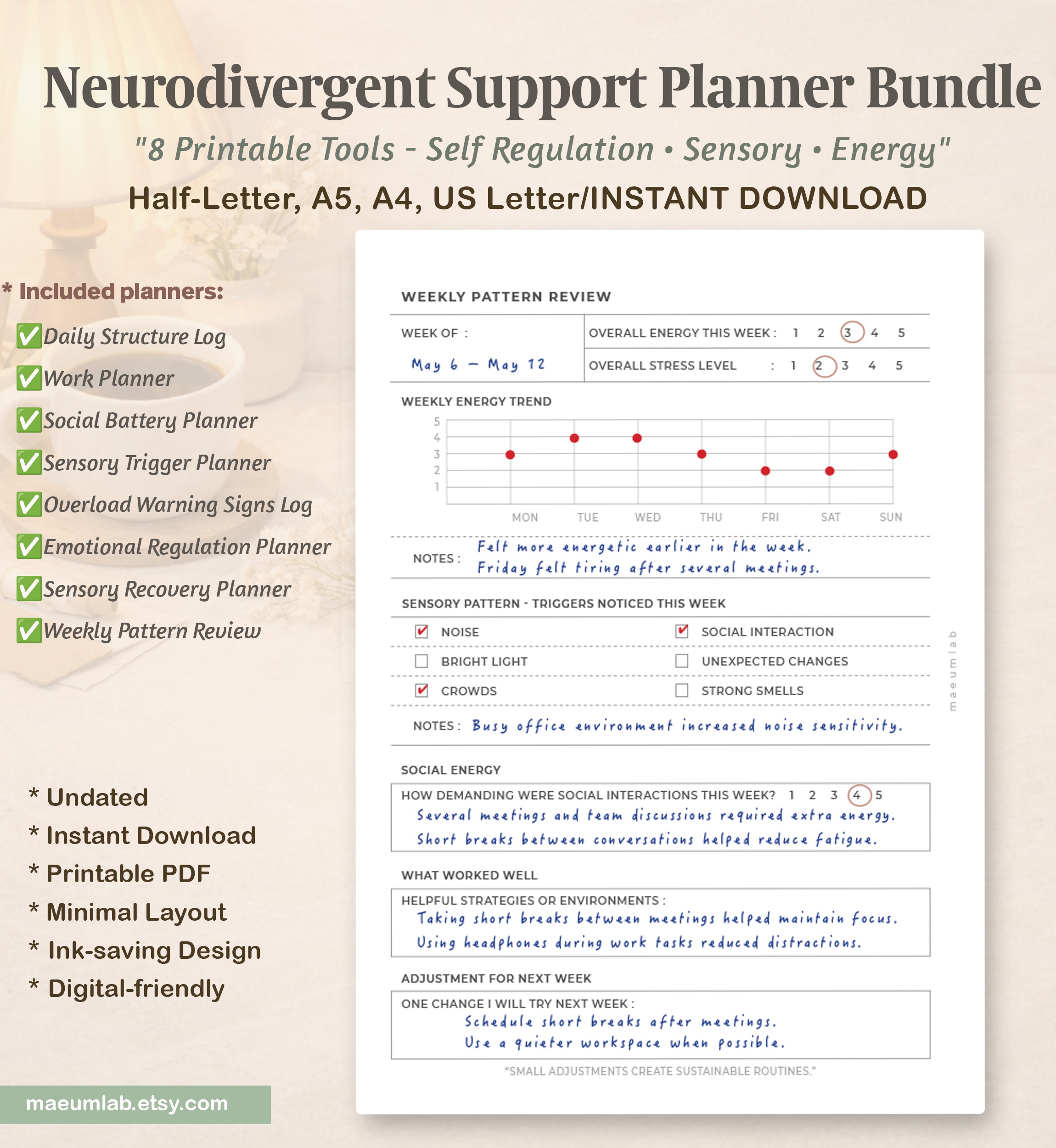
The Weekly Pattern Review brings together what you noticed throughout the week — your energy, stress, sensory triggers, social demands, and helpful supports.
You don’t need to complete every other planner before using this page.
Use whatever information you have to identify a few meaningful patterns and decide what you might adjust next week.
1. CHECK THE WEEK OVERALL
Start by recording the week and rating:
Overall Energy This Week: 1–5
Overall Stress Level: 1–5
Don’t calculate an exact average.
Choose the number that best represents how the week felt overall.
2. MAP YOUR ENERGY TREND
Mark your energy level for each day:
Monday → Sunday
Then look at the shape of the week.
Ask yourself:
When was my energy highest?
When did it begin to drop?
Was anything different on those days?
Example:
Felt more energetic earlier in the week. Friday felt tiring after several meetings.
The graph is meant to show a pattern — not measure your performance.
3. REVIEW SENSORY PATTERNS
Check the triggers you noticed during the week:
- Noise
- Bright light
- Crowds
- Social interaction
- Unexpected changes
- Strong smells
Then add a short note if something stands out.
Example:
Busy office environment increased noise sensitivity.
Repeated triggers can help you identify environments or situations that may require additional support.
4. REVIEW YOUR SOCIAL ENERGY
Rate:
How demanding were social interactions this week? 1–5
Then briefly note what affected your social energy.
Example:
Several meetings and team discussions required extra energy.
Also notice what helped:
Short breaks between conversations helped reduce fatigue.
This can help you plan social demands alongside your available energy rather than treating them as invisible work.
5. IDENTIFY WHAT WORKED WELL
Record the strategies, supports, or environments that helped most.
Example:
Taking short breaks between meetings helped maintain focus.
Using headphones during work tasks reduced distractions.
This section is important.
The Weekly Review isn’t only about identifying problems — it’s also about discovering what you may want to repeat.
6. CHOOSE AN ADJUSTMENT FOR NEXT WEEK
Finish with:
One change I will try next week
Keep it realistic.
Example:
Schedule short breaks after meetings.
Use a quieter workspace when possible.
You don’t need to redesign your entire week.
One useful adjustment is enough.
USE THE OTHER PAGES AS CLUES
If you’re unsure what to write, look back at your other planner pages.
Your:
Daily Structure Log may show when routines became difficult.
Work Planner may reveal demanding work periods.
Social Battery Planner may show which interactions used the most energy.
Sensory Trigger Planner may reveal recurring sensory demands.
Overload Warning Signs Log may show your earliest signals.
Emotional Regulation Tracker may reveal emotional and physical patterns.
Sensory Recovery Planner may show which recovery strategies worked best.
Bring those clues together here.
REMEMBER
You aren’t reviewing the week to judge how well you performed.
You’re looking for information that can make the next week more supportive.
Notice the pattern. Keep what works. Adjust what doesn’t.
BUILD A SUPPORT SYSTEM THAT FITS YOU
Notice • Understand • Support • Adjust
There is no single “right” way to use this planner bundle.
Some days you may need structure.
Some days you may need to understand a sensory trigger.
Some days the most useful thing you can do is recognize that your energy is low and make room for recovery.
The Neurodivergent Support Planner Bundle is designed to help you respond to what you need — not force yourself into the same routine every day.
USE WHAT YOU NEED
You don’t need to complete all 8 planners.
Choose the tool that matches the situation, use it for as long as it’s helpful, and return to another page when your needs change.
Over time, your pages may begin to show you:
- What drains your energy
- What contributes to sensory overload
- Your earliest warning signs
- Which situations require more recovery
- What helps you regulate
- Which environments support you best
- What routines make daily life easier
These patterns can become your personal guide for making everyday life more supportive.
SMALL ADJUSTMENTS MATTER
Support doesn’t always require a major change.
Sometimes it looks like:
Taking a break earlier.
Using headphones before the noise becomes overwhelming.
Leaving more recovery time after a meeting.
Reducing the number of tasks on a low-energy day.
Choosing a quieter environment when possible.
Small adjustments can make a meaningful difference when they are based on what you actually need.
KEEP WHAT WORKS
There is no need to make every strategy work.
Try something.
Notice what happens.
Keep what helps.
Adjust what doesn’t.
And allow your support system to change as you learn more about yourself.
YOU DON’T HAVE TO PLAN FOR A PERFECT DAY.
PLAN FOR THE SUPPORT YOU MAY NEED ALONG THE WAY.
Notice your patterns. Respect your capacity. Build support that fits you.
Thank you for choosing maeumlab.
Thoughtful tools for neurodivergent everyday life.
MaeumLab
Practical planning tools designed for neurodivergent minds.
Explore more printable support systems, planning tools, and resources at MaeumLab Resource Library.