
How to Use the 28-Day ADHD Goal & Momentum System
Introduction
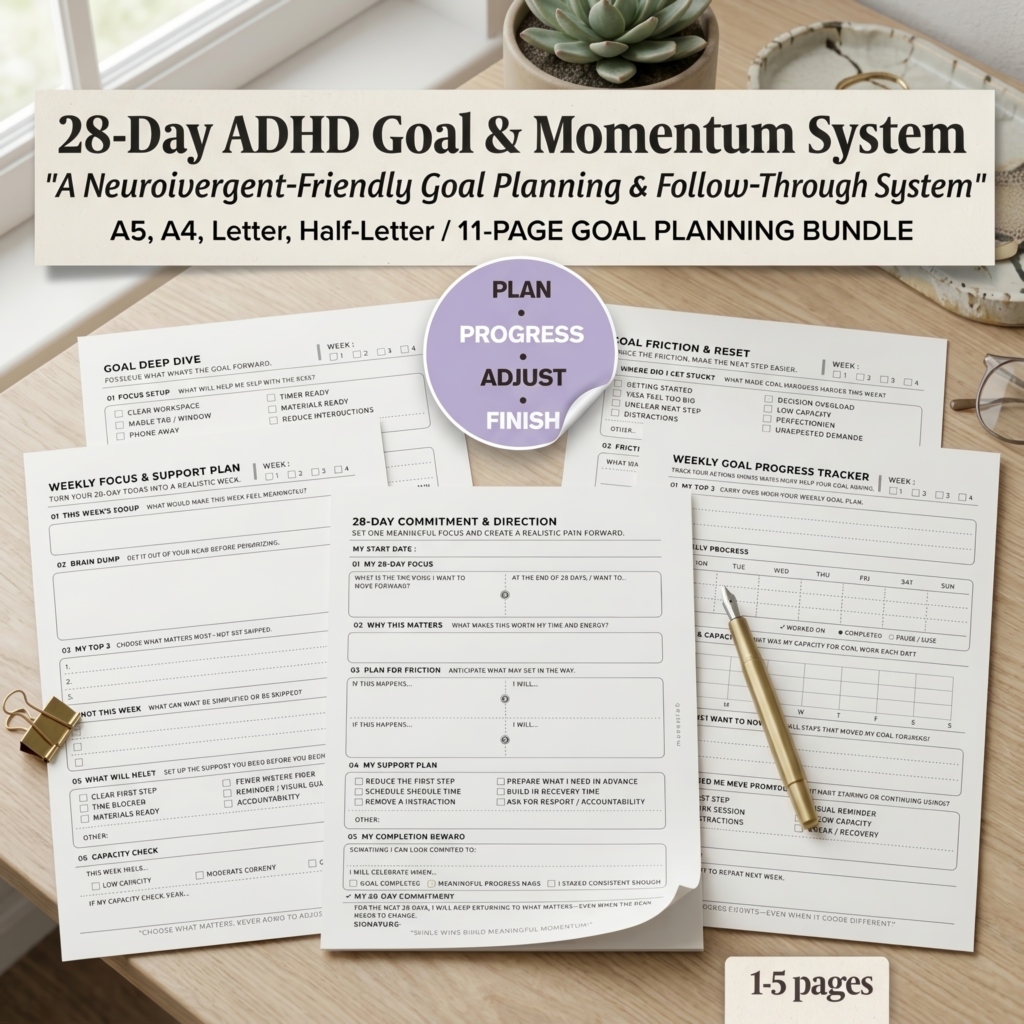
The 28-Day ADHD Goal & Momentum System is designed to help you move one meaningful goal forward without relying on perfect routines, constant motivation, or rigid daily plans.
Instead of asking you to stay consistent every single day, the system helps you work with your real-life capacity — breaking goals into smaller steps, adjusting when plans change, recovering from interruptions, and returning to what matters.
Over 28 days, you’ll move through a flexible cycle of planning, action, tracking, resetting, adjusting, and reflection — so progress can continue even when momentum isn’t perfect.
You don’t need 28 perfect days. You just need a way to keep returning to your goal.
1.Commitment & Direction
Start with one meaningful focus.
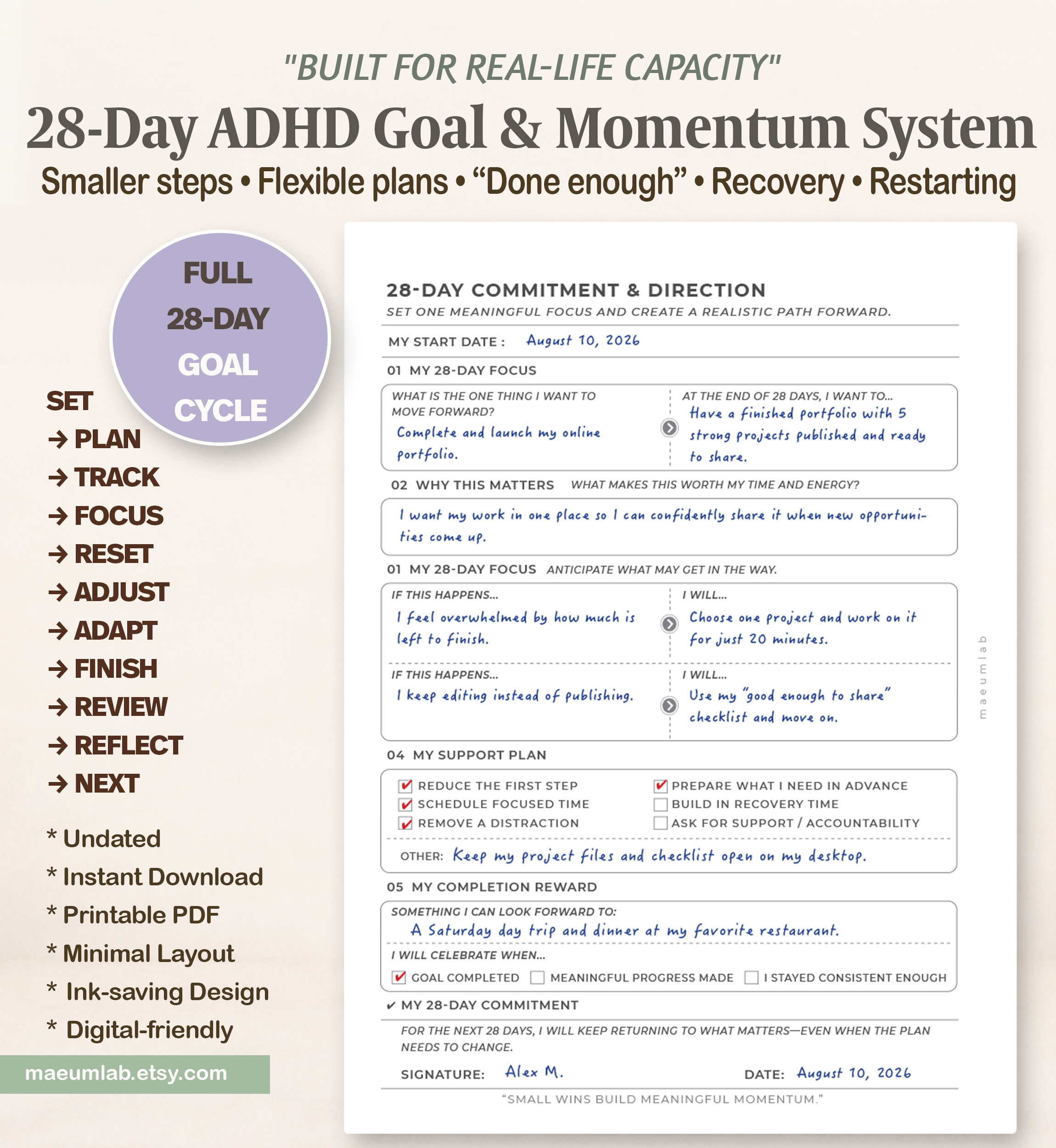
Before planning individual tasks, use this page to decide what you want to move forward over the next 28 days — and why it matters to you.
How to Use
- Choose your 28-day focus
Write one goal you want to move forward and describe what meaningful progress could look like at the end of 28 days. - Define why it matters
Write down why this goal deserves your time and energy. This gives you something to return to when motivation drops. - Plan for obstacles before they happen
Use the “If this happens… / I will…” prompts to anticipate common barriers such as overwhelm, perfectionism, distraction, or low energy. - Build your support plan
Choose the supports that make starting and continuing easier — reducing the first step, scheduling focused time, removing distractions, preparing materials, adding recovery time, or asking for support. - Choose a completion reward
Give yourself something positive to look forward to. You can celebrate full completion or meaningful progress.
Remember
Your commitment is to the direction, not to a perfect plan.
If the plan stops working, change the plan — not the goal automatically.
2.Weekly Focus & Support Plan
Turn your 28-day direction into a realistic week.
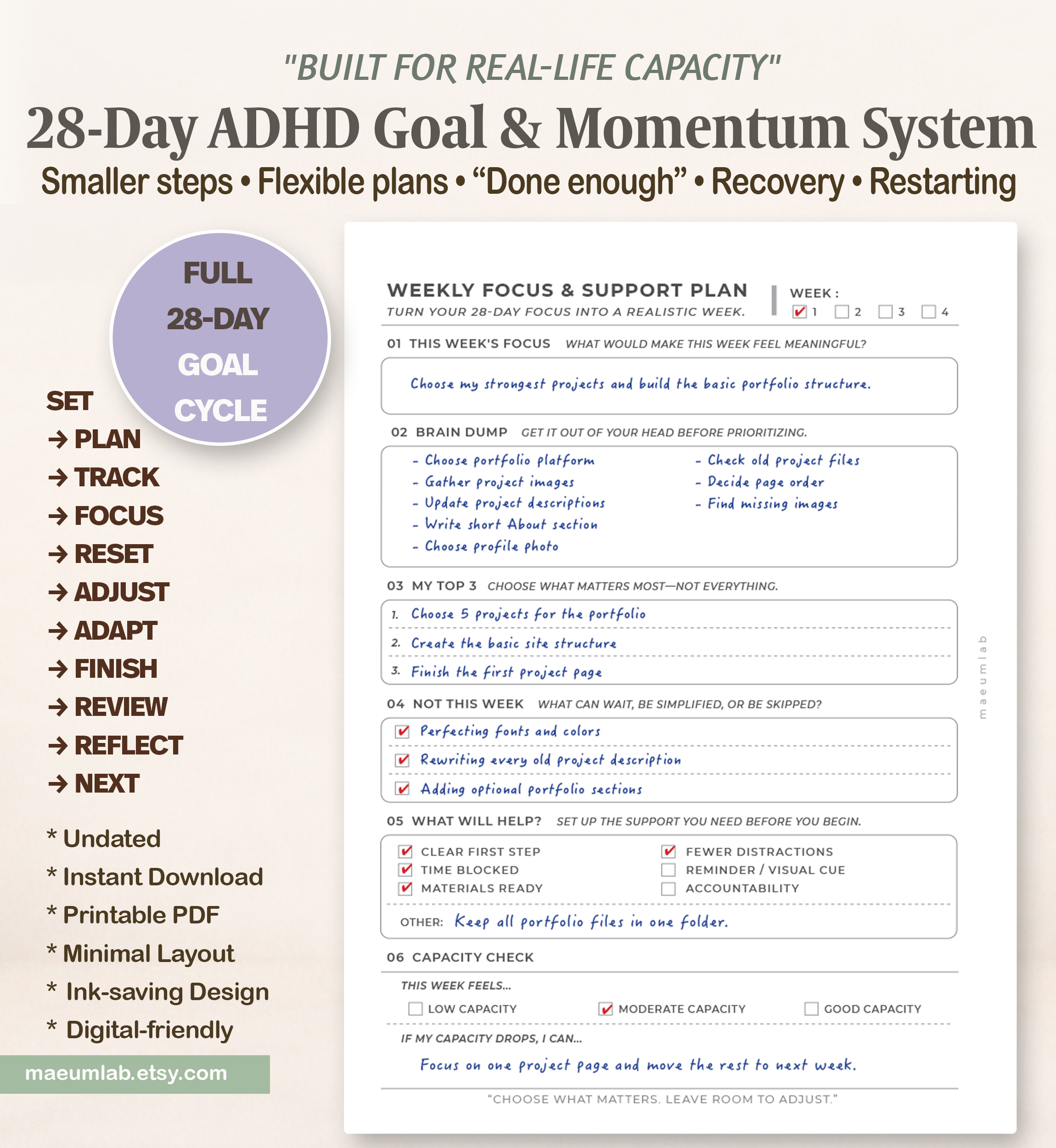
At the beginning of each week, use this page to decide what matters most based on your current capacity — rather than trying to tackle everything at once.
How to Use
- Choose one weekly focus
Ask yourself what would make this week feel meaningful. Your weekly focus does not need to cover your entire 28-day goal. - Brain dump everything on your mind
Write down tasks, ideas, reminders, and unfinished pieces before deciding what actually needs your attention. - Choose your Top 3
Select only three priorities that will move your goal forward. Think meaningful progress, not maximum productivity. - Create a “Not This Week” list
Move nonessential tasks, perfectionism, optional improvements, and things that can wait out of your active workload. - Set up support before you start
Choose what will make action easier — a clear first step, blocked time, prepared materials, fewer distractions, visual reminders, or accountability. - Check your capacity
Mark whether you’re working with low, moderate, or good capacity. Then decide in advance what you can simplify if your capacity drops.
Remember
Your weekly plan is allowed to change.
Protect the priorities that matter most and adjust the rest to the capacity you actually have.
3.Weekly Goal Progress Tracker
Track progress without turning consistency into an all-or-nothing rule.
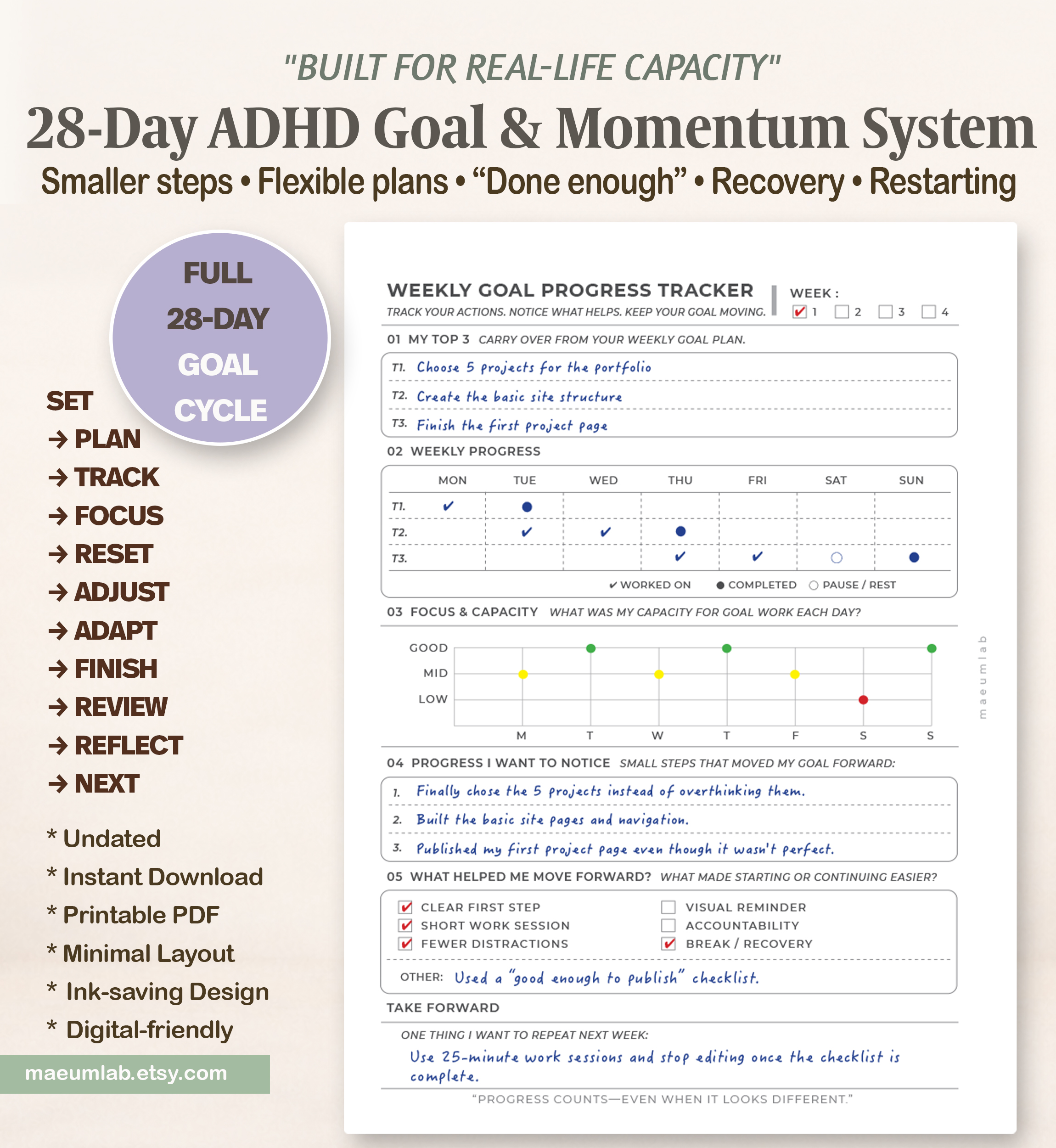
Use this page throughout the week to see how your Top 3 goals are actually moving. Track action, completion, pauses, and capacity so you can recognize progress even when every day looks different.
How to Use
- Carry over your Top 3
Bring the three priorities you selected in your Weekly Focus & Support Plan onto this page. - Track what happened each day
Mark whether you worked on, completed, or paused/rested for each goal. A rest day doesn’t erase the progress you already made. - Notice your daily capacity
Use the Focus & Capacity section to record whether your capacity for goal work felt low, moderate, or good. Over time, this can help you see when goal work tends to feel easier or harder. - Record progress worth noticing
Write down the small actions that moved your goal forward — especially the ones that might normally feel “too small” to count. - Identify what helped
Notice which supports made starting or continuing easier, such as shorter work sessions, fewer distractions, a clear first step, accountability, or recovery time. - Take one thing forward
Choose one strategy that worked and intentionally carry it into the next week.
Remember
Progress doesn’t have to happen every day to be real progress.
Track what happened, learn from it, and keep the goal moving.
4.Goal Deep Dive
Protect your focus and work on what actually moves the goal forward.
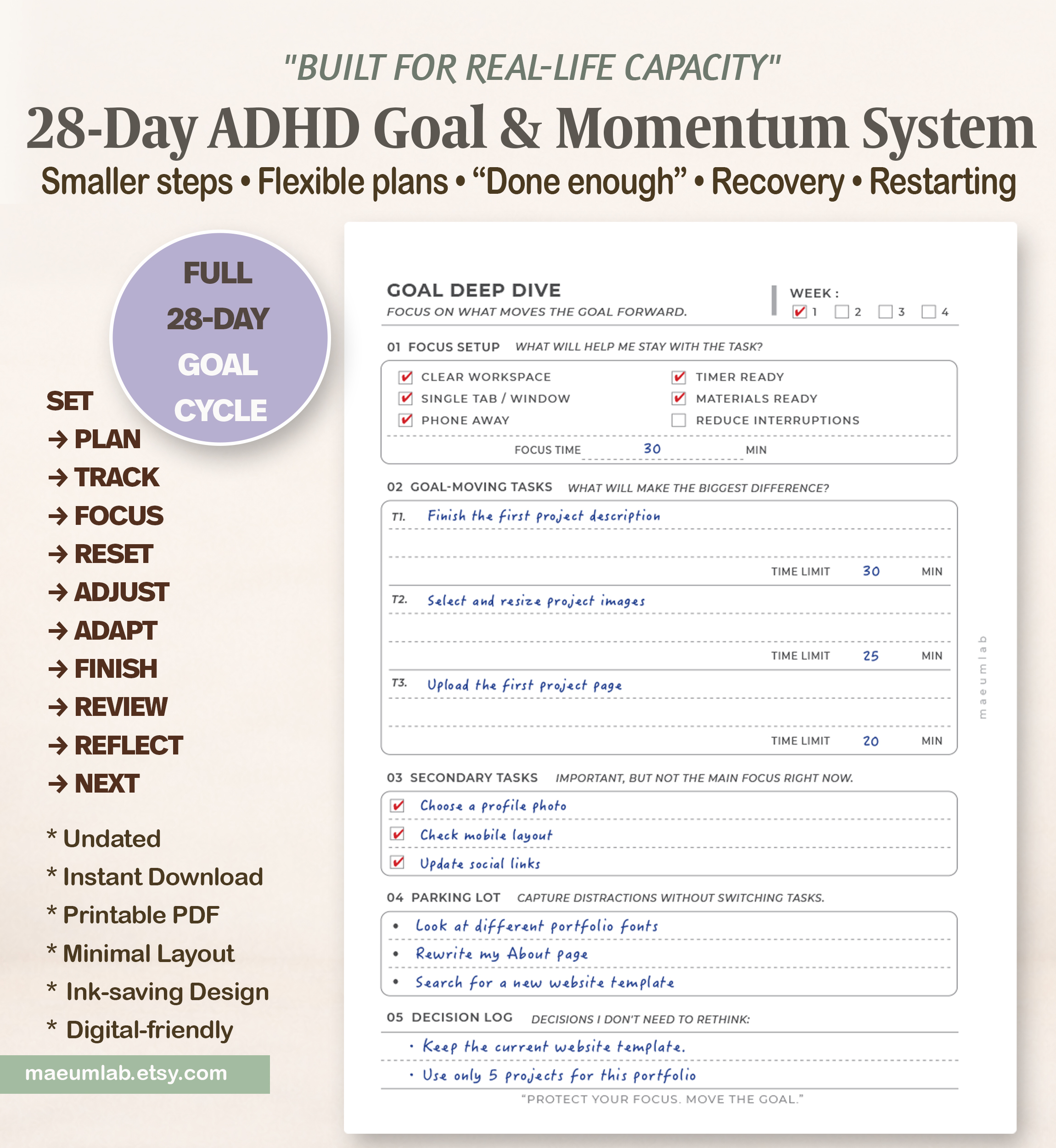
Use this page when you’re ready for a focused work session. It helps you prepare your environment, choose the highest-impact tasks, and keep distractions or new ideas from pulling you away from the work that matters.
How to Use
- Set up your focus environment
Before starting, choose the supports that will make staying with the task easier — a clear workspace, one tab or window, phone away, timer ready, materials prepared, or fewer interruptions. - Choose your goal-moving tasks
Identify up to three actions that will make the biggest difference to your goal. Give each task a realistic time limit so the session stays contained and easier to start. - Separate secondary tasks
Capture useful tasks that matter but don’t need your attention right now. This keeps them visible without letting them compete with your main focus. - Use the Parking Lot
When unrelated ideas, improvements, or “I should also…” thoughts appear, write them here instead of switching tasks. You can return to them later. - Record decisions you don’t need to rethink
Use the Decision Log for choices you’ve already made. This can reduce repeated decision-making and help you keep moving instead of reopening the same questions.
Remember
Not every useful task deserves your attention right now.
Protect the work that moves the goal — and give everything else a safe place to wait.
5.Goal Friction & Reset
When progress stalls, change the conditions — not just your effort.
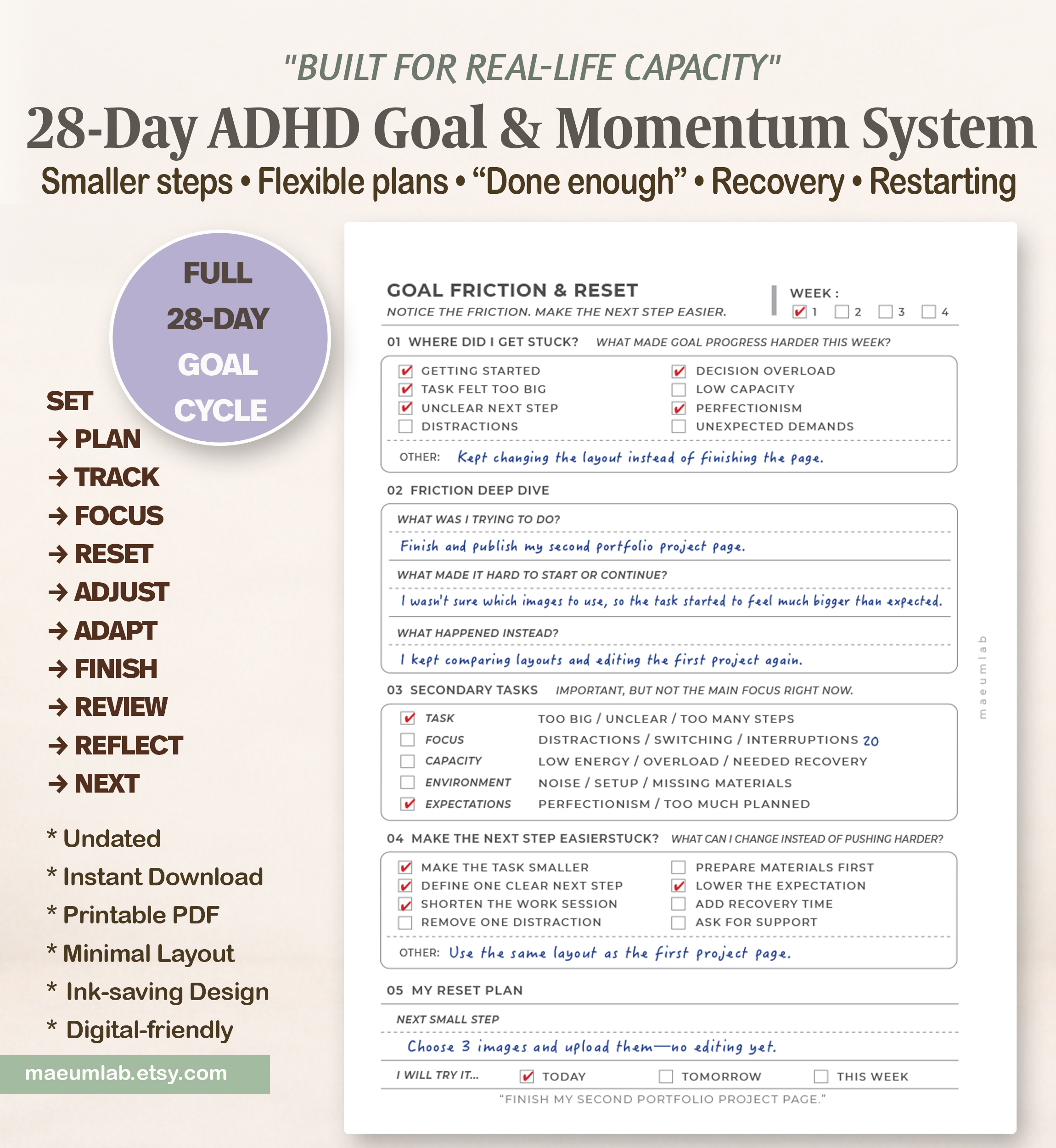
Use this page whenever a goal starts to feel difficult to begin, continue, or finish. Instead of treating a stuck point as failure, identify the friction and redesign the next step so it feels easier to re-enter the goal.
How to Use
- Notice where you got stuck
Check what made progress harder — getting started, a task that felt too big, an unclear next step, distractions, decision overload, low capacity, perfectionism, or unexpected demands. - Look at what actually happened
Choose one specific stuck point. Write what you were trying to do, what made it difficult, and what you ended up doing instead. - Identify the type of friction
Ask whether the problem came mainly from the task, focus, capacity, environment, or expectations. This helps you change the right thing rather than assuming you simply need more motivation. - Make the next step easier
Reduce the task, define one clear action, shorten the work session, remove a distraction, prepare materials, lower the expectation, add recovery time, or ask for support. - Create your reset plan
Write one small, concrete next step and choose when you’ll try it. The goal here is not to “catch up” — it’s simply to restart.
Remember
Getting stuck is information, not the end of the goal.
Reduce the friction, choose a smaller next step, and begin again from where you are.
6.Goal Plan Adjustment
Adjust the plan to fit your capacity — without losing the goal.
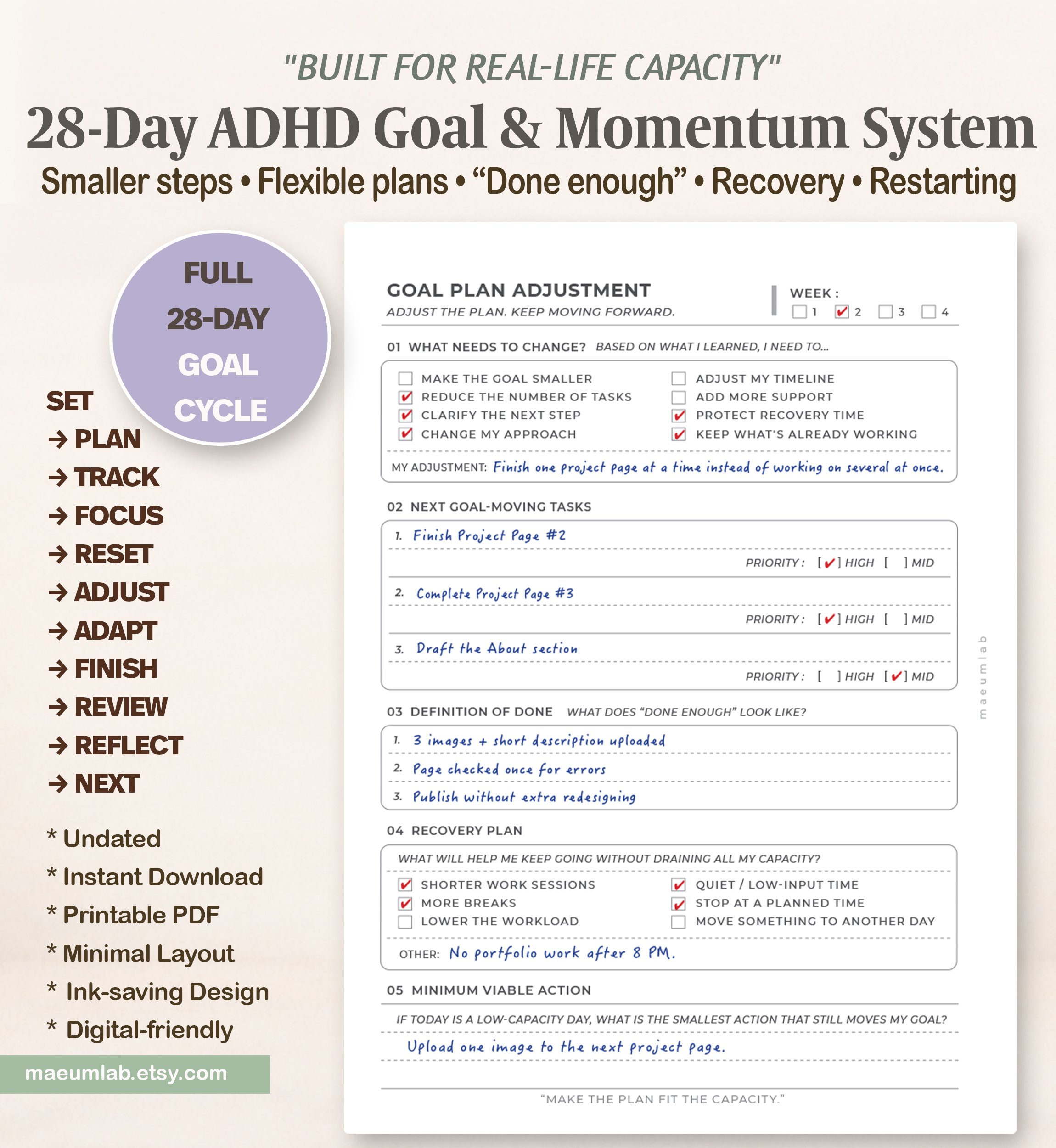
Use this page after a difficult week, a change in capacity, or whenever your original plan no longer feels realistic. The goal is not to catch up. It is to decide what needs to change so you can keep moving forward.
How to Use
- Decide what needs to change
Review what you learned from the previous week. Make the goal smaller, reduce the number of tasks, clarify the next step, adjust the timeline, add support, or protect more recovery time. Keep anything that is already working. - Choose your next goal-moving tasks
Write up to three actions that will move the goal forward. Give each one a priority so you know what deserves your limited attention first. - Define “done enough”
Decide what completion actually looks like before you start. Keep it specific and realistic. This helps prevent perfectionism from quietly expanding the task. - Protect recovery
Choose what will help you continue without using all of your capacity — shorter sessions, more breaks, quieter work time, a stopping time, or a lighter workload. - Create a Minimum Viable Action
Ask: “On a low-capacity day, what is the smallest action that would still move this goal forward?” – This becomes your backup plan for difficult days.
Remember
The goal can stay the same while the plan changes.
Adjusting is part of progress — not evidence that the original plan failed.
7.Goal Adaptation Tracker
Adapt as needed. Stay connected to the goal.
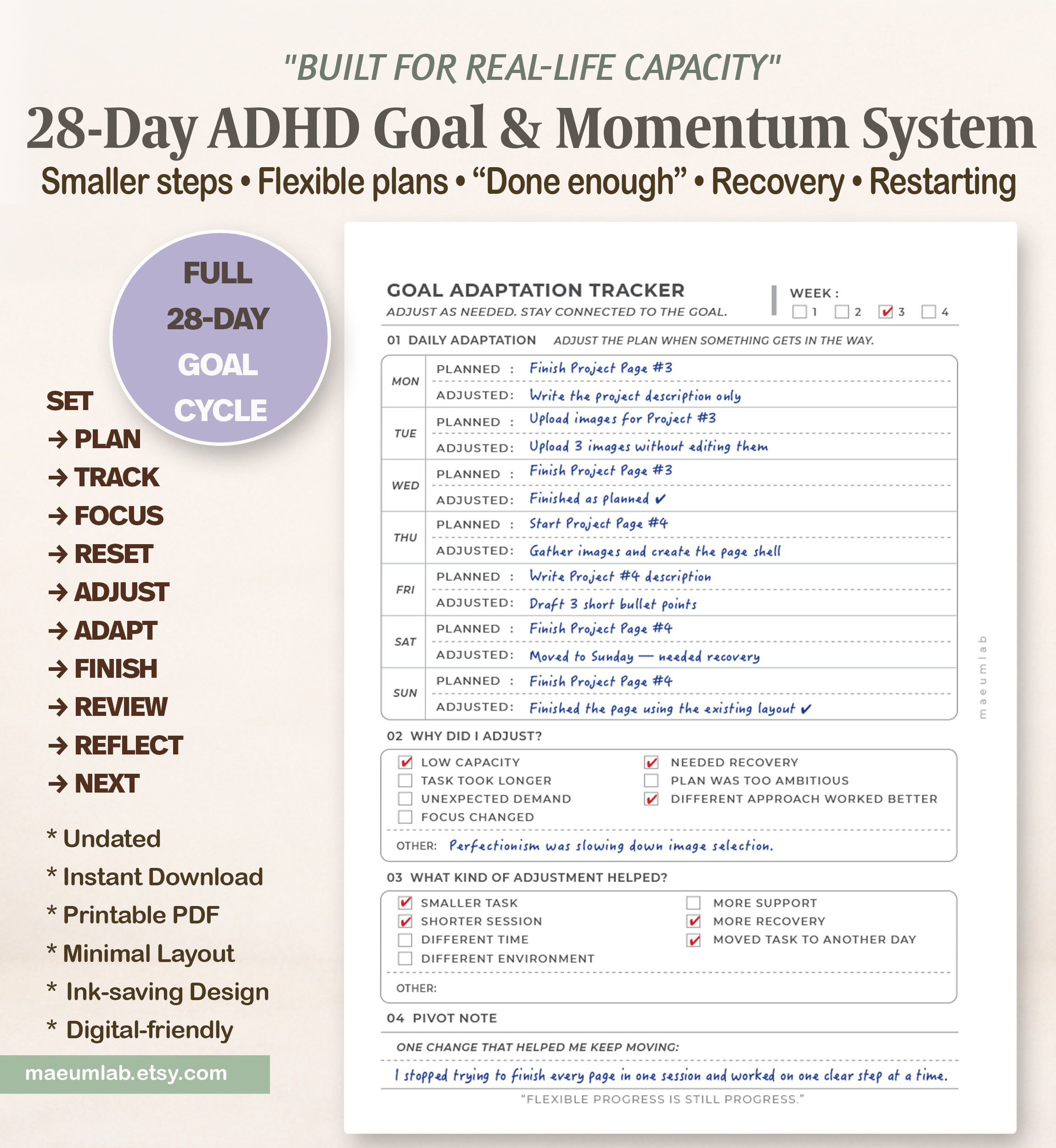
Plans rarely unfold exactly as expected. Use this tracker throughout the week to record how you adapted your actions when capacity, recovery needs, time, or circumstances changed.
How to Use
- 1. Compare Planned → Adjusted
For each day, write what you originally planned and what you actually chose to do instead. An adjustment can mean making the task smaller, simplifying it, postponing it, or completing it differently. - Notice why you adjusted
At the end of the week, identify what caused the changes — low capacity, recovery needs, unexpected demands, an ambitious plan, or simply discovering a better approach. - Identify what kind of adjustment helped
Notice which strategies kept you moving: smaller tasks, shorter sessions, different timing, more recovery, added support, or moving something to another day. - Capture your Pivot Note
Write one change that made it easier to stay connected to your goal. This becomes useful information for the next week.
Remember
Flexible progress is still progress.
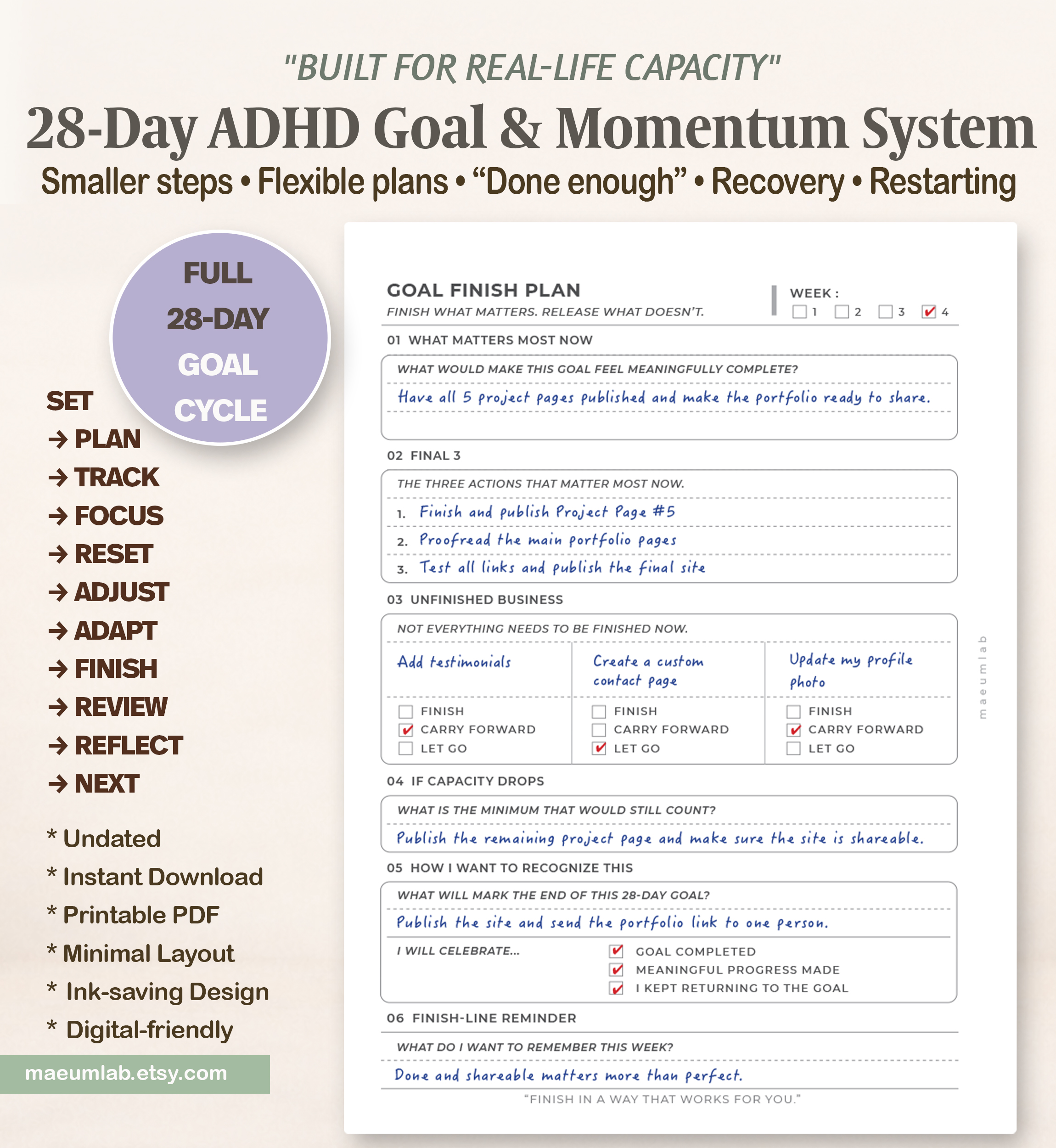
8.Goal Finish Plan
Finish what matters. Release what doesn’t.
How to Use
- Define what matters most now
Decide what would make your 28-day goal feel meaningfully complete. - Choose your Final 3
Narrow your attention to the three actions that matter most for finishing. - Sort unfinished business
Decide what to finish, carry forward, or let go instead of trying to complete everything. - Plan for lower-capacity days
Define the minimum that would still count if your capacity drops. - Recognize the finish
Choose what will mark the end of this goal cycle and how you want to acknowledge your progress. - Leave yourself a finish-line reminder
Write one thing you want to remember as you complete the final week.
Remember
Finish in a way that works for you.
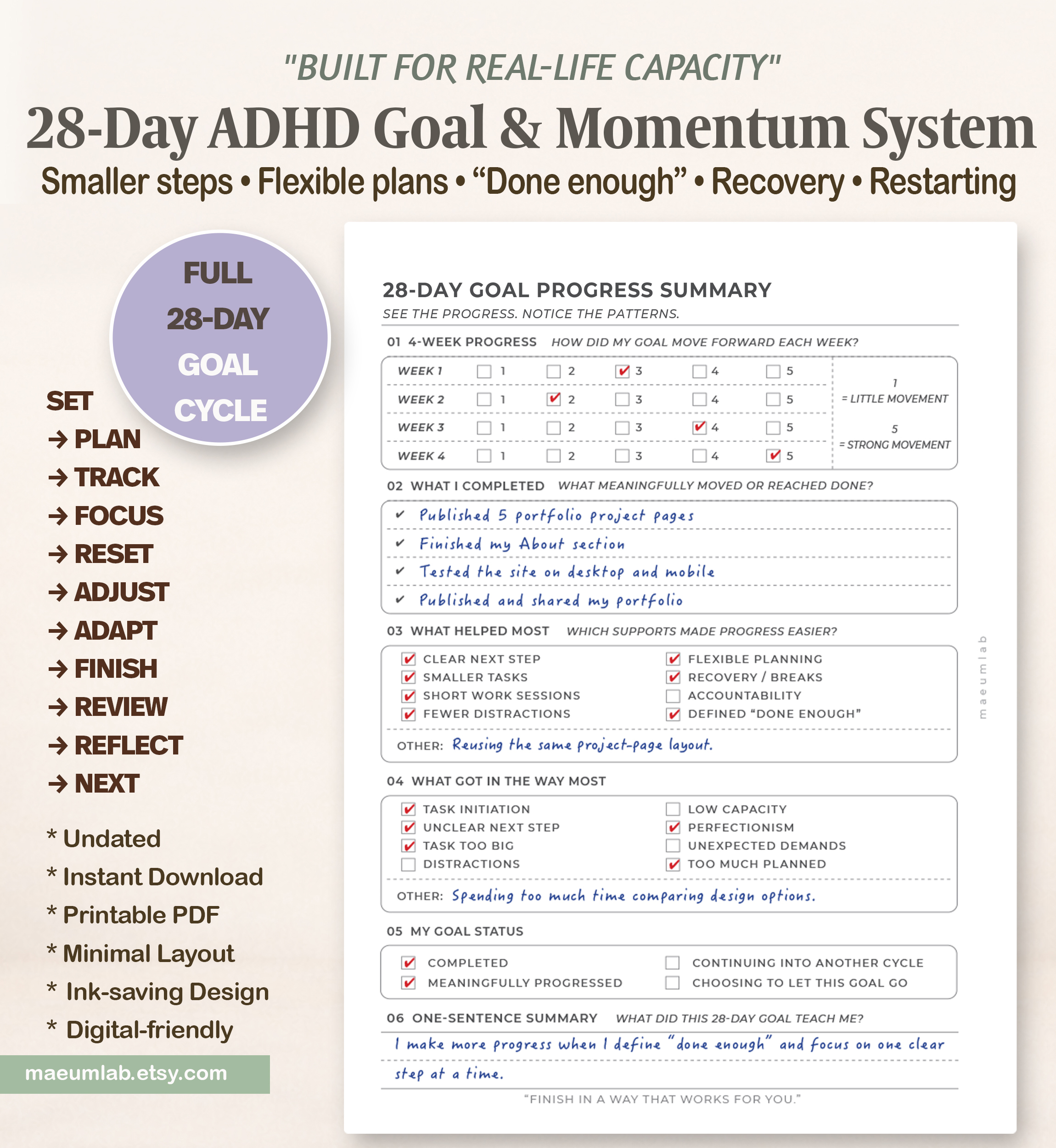
9.28-Day Goal Review
Look back at the full 28 days and notice what actually moved your goal forward.
How to Use
- Rate your 4-week progress
Rate how much your goal moved forward each week from 1–5. - Record what you completed
Write down the meaningful actions, milestones, or results you reached. - Notice what helped most
Identify the supports and strategies that made progress easier. - Notice what got in the way
Mark the patterns that repeatedly made starting, continuing, or finishing harder. - Check your goal status
Decide whether the goal is complete, meaningfully progressed, continuing into another cycle, or ready to be released. - Write your one-sentence summary
Capture the most important thing this 28-day goal cycle taught you.
Remember
Progress is information. Use what you learned for what comes next.
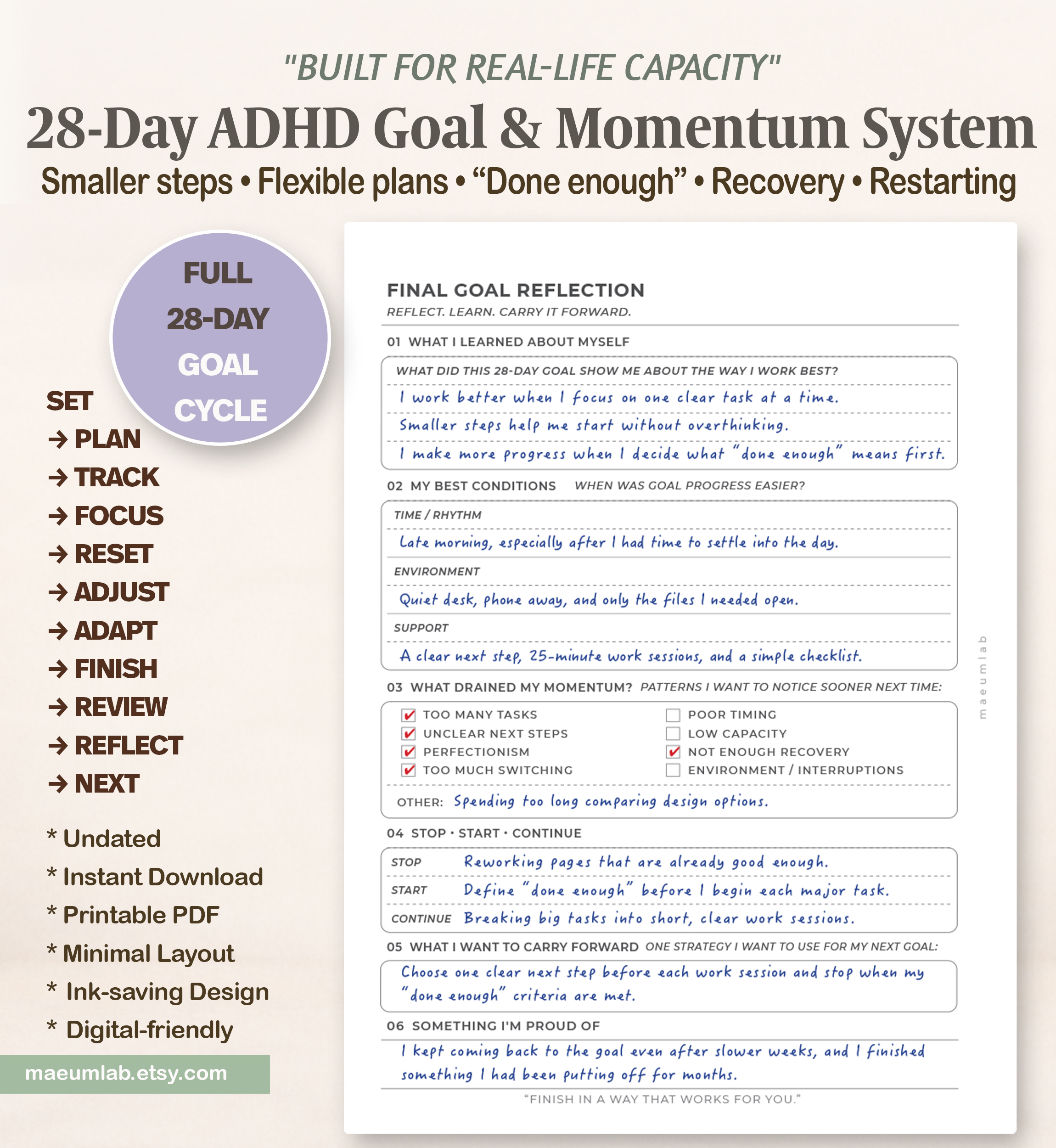
10.Final Goal Reflection
Reflect on what you learned — not just what you finished.
How to Use
- Reflect on what you learned about yourself
Notice what this 28-day cycle taught you about the way you work best. - Identify your best conditions
Record the timing, environment, and support that made goal progress easier. - Notice what drained your momentum
Identify patterns that made it harder to start, continue, or return to your goal. - Stop · Start · Continue
Decide what to stop doing, what to begin doing, and what is worth continuing. - Choose what to carry forward
Select one strategy or lesson you want to bring into your next goal cycle. - Recognize something you’re proud of
Acknowledge the progress, persistence, or change that mattered to you.
Remember
Reflect. Learn. Carry it forward.
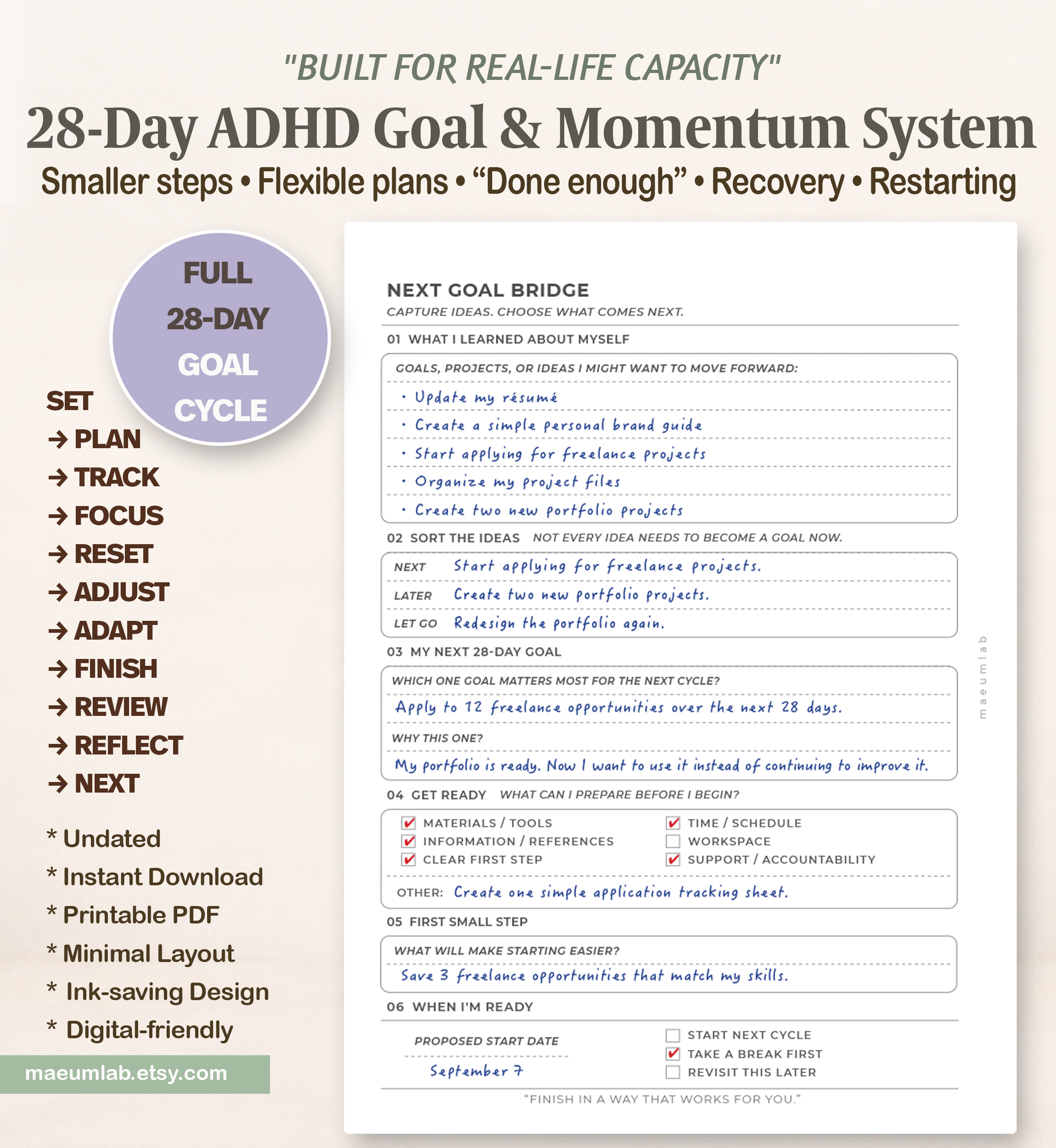
11.Next Goal Bridge
Carry what you learned into what comes next.
How to Use
- Capture what might come next
List the goals, projects, or ideas you may want to move forward. - Sort your ideas
Decide what belongs in Next, Later, or Let Go. Not every idea needs to become a goal. - Choose your next 28-day goal
Select the one goal that matters most for your next cycle and write why you chose it. - Get ready
Prepare the tools, information, time, workspace, or support that can make starting easier. - Define the first small step
Choose one simple action that lowers the barrier to beginning. - Decide when you’re ready
Set a possible start date—or intentionally choose to rest before beginning another cycle.
Remember
You don’t have to start the next goal immediately. Carry the learning forward first.
YOUR 28 DAYS, YOUR WAY
This system is not about following a perfect plan.
It’s about building momentum in a way that works with your capacity.
Some days you’ll move forward.
Some days you’ll adjust, pause, or restart.
All of it is part of the process.
Use the pages you need, return to what helps, and let the system flex with you.
Small steps. Flexible plans. Meaningful momentum.
— maeumlab
MaeumLab
Practical planning tools designed for neurodivergent minds.
Explore more printable support systems, planning tools, and resources at MaeumLab Resource Library.